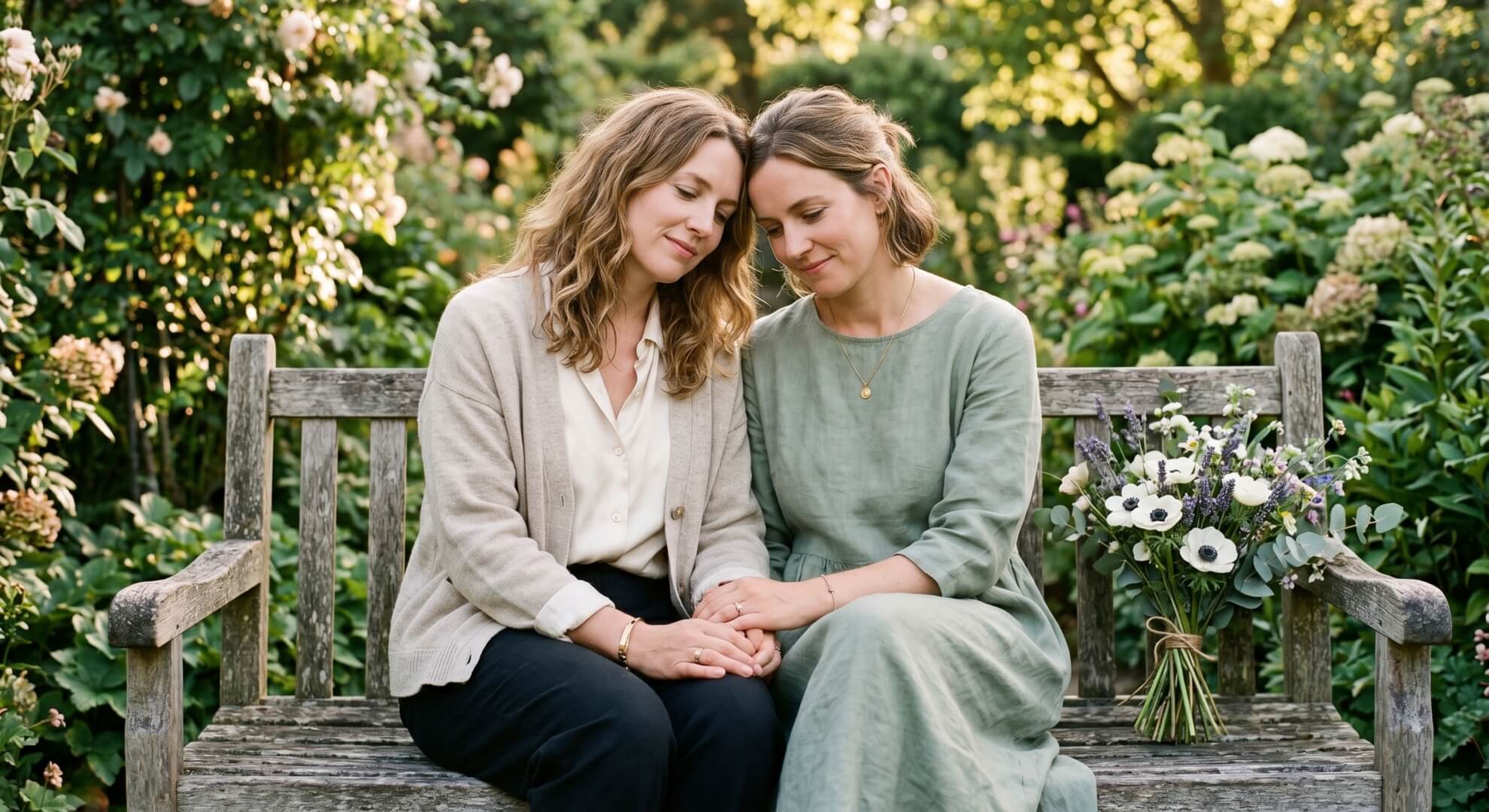


The woman at the bedside has been there for 11 days. She knows which playlist settles the room, which nurse to flag when the breathing turns shallow, and how her friend likes the pillows angled in the long afternoon.
When the social worker arrives with a clipboard, the first question concerns next of kin. The woman’s name does not fit the box she is handed.
She is not a sister or a wife. She is the person who came, and stayed, and learned the rhythm of a dying body the way only the devoted ever do.
DISCLOSURE: This post contains affiliate links. When you purchase through these links, I may receive a small commission that helps me continue to provide these resources for your journey, at no extra cost to you. I only recommend resources I believe in.
The People the Form Cannot See
A specific fear travels quietly among people whose deepest bonds were never notarized. It is the worry that when the body finally fails, the people who actually love them will be eased to the edge of the room while strangers with the right surnames are waved to the center.
Hospitals run on legal proximity. The chart asks for next of kin, the consent forms assume a spouse or an adult child, and the entire apparatus presumes that blood and marriage map cleanly onto devotion.
For a great many people, that map is simply wrong. The person who holds the spare key, who knows the medication schedule by heart, who has sat through every scan, may share no genealogy with the patient at all.
Meanwhile a brother three states away, absent for a decade, can be summoned by the chart to make decisions he is in no position to make well. The system does not ask who has earned the role; it asks only who is related.
The same logic governs the smaller decisions that fill a hospital stay. Who is called first when something changes, who is allowed past the nurses’ station after hours, and who is consulted about pain medication all tend to follow the listed relationship rather than the lived one.
What unsettles people is not only the prospect of dying. It is the prospect of dying inside a system that cannot read the actual shape of their life, and that may quietly hand their final hours to whoever the records happen to prefer.
A Wider Circle Than the Law Admits
This arrangement is neither new nor rare. People pushed to the margins have long assembled kinship out of friendship, because the families they were born into could not, or would not, hold them.
Queer communities named the pattern first and most plainly, but the circle reaches much further. It takes in the never-married and the long-divorced, the immigrant whose relatives live an ocean away, the person whose siblings have hardened into strangers across the decades, and the elder whose own generation has mostly died.
Among younger adults, the pattern has become close to ordinary. Marriage arrives later or not at all, work scatters people across the map, and the household of the heart is often a group of friends rather than a bloodline.
The shift is visible in the plainest demographic terms. People now marry later than at any point in modern record-keeping, live alone in steadily rising numbers, and increasingly rely on friends for the everyday support that earlier generations expected from a spouse or a grown child.
These are not lesser families, assembled as consolation prizes for the unlucky. They are simply families that the paperwork was never designed to see, and the failure of recognition belongs to the form, not to the bond.
Kinship Has Always Been Chosen
The notion that a family is a married couple and their biological children is younger and narrower than it looks. Across most of human history, and across most of the world, kinship has been something people make as much as something they inherit.
In the early seventies, the anthropologist Carol Stack spent years inside a poor Black community she called The Flats, tracing how survival depended on wide webs of mutual aid. Neighbors and friends shared food, money, childcare, and shelter through ties they treated as kinship, whether or not blood ran between them.1
Stack found that these networks were not a thin substitute for the real thing. They were the real thing, the structure that decided who ate, who was sheltered, and who would be cared for when illness arrived.
Other cultures have long encoded the same truth in plainer terms. Systems of godparenthood across Latin America and southern Europe bind unrelated adults into lifelong obligation, and many languages hand the warm names of aunt and uncle to those who are kin by love rather than by descent.
What Stack documented was not poverty improvising a clever workaround. It was a pattern as old as scarcity and affection, surfacing wherever the official family falls short of the one people actually live within.
When Friendship Does the Work of Family
The phrase chosen family entered common speech through hardship. During the worst years of the AIDS crisis in the eighties, many gay men were abandoned by the relatives who should have stood beside them, and friends stepped in to nurse the sick, to fight hospitals for access, and to bury the dead when no one else would.
Those friends learned to do everything a family does under pressure. They administered medication, kept watch through the night, planned funerals that estranged relatives refused to attend, and carried a grief that the surrounding culture would not name.
The anthropologist Kath Weston, studying gay and lesbian communities in San Francisco, found that these relationships were understood as kinship in the fullest sense. They were defined not by blood or law but by a durable solidarity that people chose, and kept choosing, day after demanding day.2
Later research sharpened the point. Studying close friendships that operated as family, the sociologist Anna Muraco found that such intentional families did not merely resemble kin; they carried out the actual labor of kinship, including care, obligation, and the steady expectation of showing up.3
This is the part that institutions miss. Affection alone does not make a family, and chosen family is not a matter of sentiment, but of the willingness to be bound, to carry weight that is never convenient, and to stay in the room when staying is the hardest thing on offer.
Who a Death Doula Counts as Family
This is more than a gentle temperament. A death doula helps a dying person name what they want while there is still time to make those wishes binding, including who should be permitted in the room and who should speak when the patient cannot.
That work matters most precisely where the law and the heart diverge. When a hospital recognizes only next of kin, a clearly designated health care surrogate can give a chosen companion the standing that biology would otherwise hand to a relative no one has seen in years.
For people who want their real circle recognized before a crisis forces the question, choosing to work with a death doula early can put the right names on the right forms while the conversation is still calm. The aim is never to erase biological family, but to keep the actual family from being moved aside at the threshold.
A death doula also steadies the friction that can flare when blood relatives and chosen family meet over a single bed. Each side may believe it knows the dying person best, and the work is to keep the dying person, rather than the hierarchy, at the center of every decision.
There are quieter tasks as well. A death doula can organize a vigil schedule so that no one keeps watch alone, can translate what the clinical team is saying when the language turns opaque, and can make sure that the people the patient most wants near are the ones actually summoned in the final hours.
A death doula counts as family whoever the dying person counts as family. The definition of family begins with the room, not with the records.
Naming Your People Before the Crisis
The remedy for an unready system is to be ready oneself. Most of the protection chosen family needs can be arranged with a handful of documents prepared well before anything goes wrong.
A durable power of attorney for health care lets a person name who will decide on their behalf, and that name need not belong to a relative. A short written directive can record who is welcome at the bedside, and a will matters all the more here, because without one most states route an estate to blood relatives by default, no matter who actually shared the life.
It helps to name a primary contact for the care team, so that updates flow first to the person the patient trusts most. Many hospitals will honor a clearly stated choice once it is written down, even when that choice is a friend rather than a relative.
These conversations are far easier at a kitchen table than in an intensive care unit. Telling the chosen family where the documents live, and what the wishes inside them are, spares those people from having to fight for a place they long ago earned.
The grief of chosen family is often left unacknowledged, because mourning is still measured by one’s listed relationship to the deceased rather than by the depth of the actual bond. This blog examined that pattern in its earlier feature on disenfranchised and ambiguous loss, which traces how unrecognized grief is left to carry itself in silence. The same blindness that overlooks a devoted friend at the bedside tends to overlook that same friend at the graveside.
The Dignity of Being Chosen
None of this guarantees that the system will behave. A friend may still be questioned at the door, and a chosen partner may still be asked to prove a love that never required proof.
Still, there is something steadying in the plain fact of being chosen at all. To be someone’s family by decision, rather than by birth, is a form of recognition that no clerk can grant and none can take away.
A death doula’s presence becomes a quiet kind of testimony. When a person trained to sit with the dying treats the friend in the chair as the closest one in the room, it confirms in the open what the paperwork tried to deny.
That confirmation can outlast the death itself. The friend who was honored at the bedside carries home the knowledge that the bond was seen, and that knowledge becomes part of how the grief is eventually borne.
The bond was real the whole time. Witnessed or unwitnessed, recorded or not, it did the work that family is meant to do.
The woman at the bedside will never appear on the chart. When the file is closed and archived, her 11 days will leave no official trace inside it.
She was the one who knew the song, who angled the pillows, who stayed long after staying turned hard. She came because she had been chosen, and she had been chosen because she was always the kind to come.
That is what a family is, in the only definition that holds any weight at the end. It is the people who are in the room.
When you imagine the people you would want beside you at the end, how many of them share your blood, and how many of them did you choose?
References
- Stack, Carol B. “All Our Kin: Strategies for Survival in a Black Community.” New York: Harper and Row, 1974. ↩︎
- Weston, Kath. “Families We Choose: Lesbians, Gays, Kinship.” New York: Columbia University Press, 1991. ↩︎
- Muraco, Anna. “Intentional Families: Fictive Kin Ties Between Cross-Gender, Different Sexual Orientation Friends.” Journal of Marriage and Family 68, no. 5 (2006): 1313–1325. ↩︎
Leave a Reply