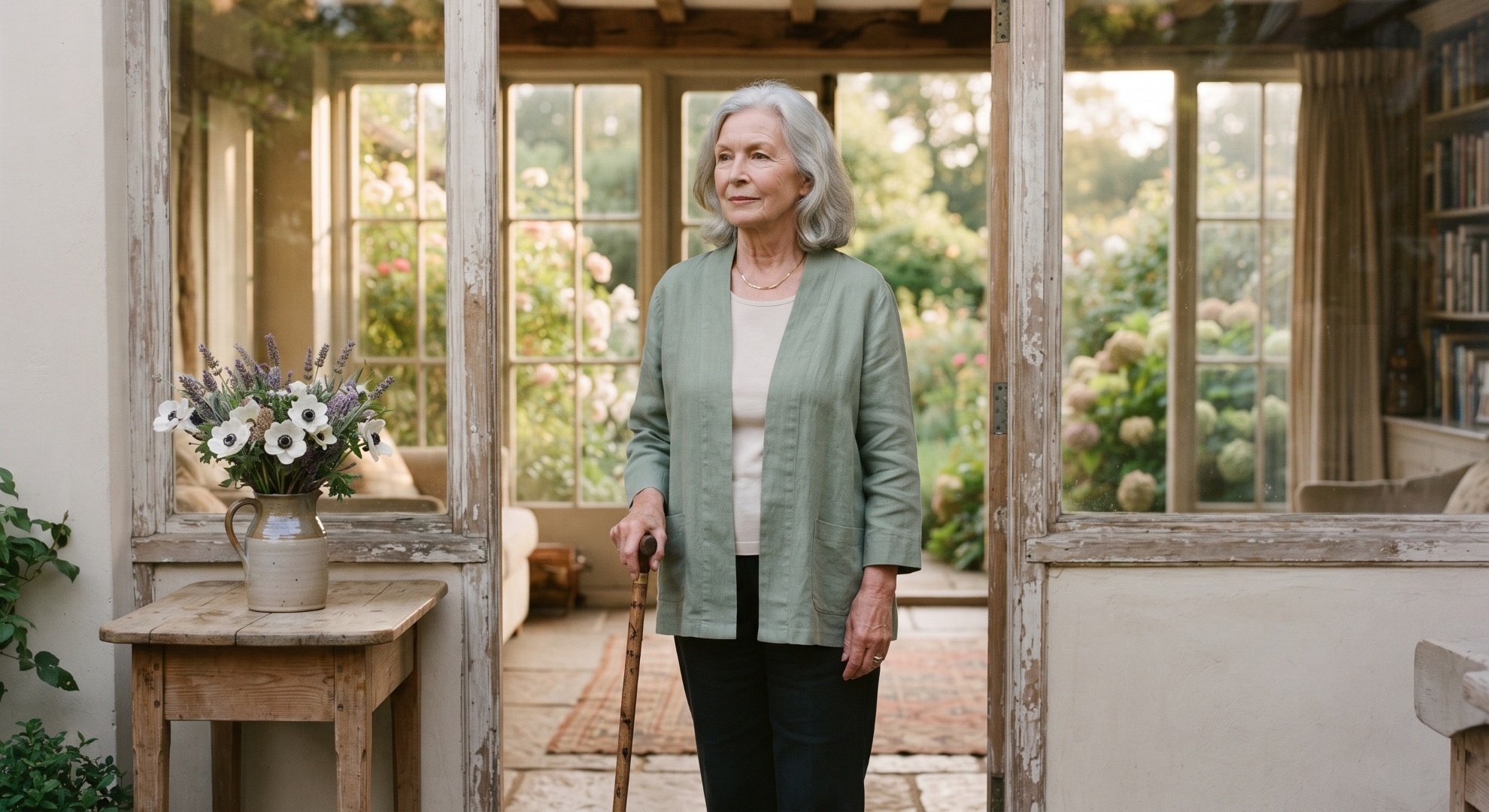


A daughter lets herself into her mother’s house on a Sunday in March and stops in the kitchen. Two plates, a glass, and a saucepan are in the sink, and they have the look of having been there since Friday. Her mother has kept this kitchen spotless for fifty years, and the daughter feels a small drop in her stomach before she can say why.
She washes the dishes, dries her hands, and tells herself that her mother has simply been tired. Neither of them mentions it over tea. Neither of them notices that the house has already begun to say something the two of them have not yet said aloud.
A home does not wait for a diagnosis to be announced. It begins to rearrange itself around a body that needs less distance, less effort, and more help, and it does so in steps too small for the people living there to count. A death doula walks into the same house and reads the whole sequence at once.
DISCLOSURE: This post contains affiliate links. When you purchase through these links, I may receive a small commission that helps me continue to provide these resources for your journey, at no extra cost to you. I only recommend resources I believe in.
The Sink Fills Up First
The earliest changes in a household are almost never medical. They are small failures of completion: a sink that is never quite empty, mail stacked on the hall table, a yard that goes a season without being cut. The family reads these as lapses, and the person living among them often reads them the same way, with a flicker of private embarrassment.
A death doula reads them as a record of how a person is spending a limited supply of energy. The woman who once finished every task before bed is now choosing, each evening, what she can afford to leave undone. The sink holds the choice she made at six o’clock, and the yard holds the choice she made in April.
This is a form of triage that nobody announces. A person who is growing weaker does not say that the lawn has been moved down the list of things that matter, but the lawn says it for them. The household has not been neglected, only reorganized around something more urgent than the grass.
The same pattern shows up in smaller places. The good tablecloth stays in the drawer, the plants on the windowsill dry out, and the calendar on the refrigerator stops being turned past a certain month. None of these is dramatic, and all of them are the house quietly adjusting its expectations of the person inside it.
Researchers who study how people live among their possessions have long argued that a home is a record of attention, a place where the priorities of a life are written in what gets kept, used, and tended.1
Read that way, the neglected corner is as informative as the cherished one. It shows exactly where the attention has gone, and it often shows it months before anyone has spoken a word about illness.
How Rooms Give Way to Needs
Then the equipment begins to arrive, and it arrives in an order. A cane appears beside the front door, usually described as a precaution. A few months later the cane has a companion, and then a replacement, as a walker takes its place against the same wall.
The house adjusts around each addition with a politeness that hides how much is being conceded. Throw rugs disappear because they catch a foot. A chair with arms is carried in from another room, and the good armchair is pushed against the window to open a wider path from the bedroom to the bathroom.
Each of these decisions is sensible, and each is made by someone thinking only about the next week. Nobody decides that the house will become a place of care. They move a lamp, clear a threshold, and agree that the new arrangement looks handy.
Books on how people actually live in their homes, room by room, make a similar point: the way a house is arranged and the way people behave inside it shape each other.2 When the routines of a person change, the rooms change with them, and the changes run in one direction. The paths get wider, the surfaces get lower, and the distances get shorter.
A death doula sees that direction at once. The cane, the walker, and the cleared pathway are not separate events. They are three frames of a single slow film, and the pace of the film says something about how quickly a person’s strength is changing.
The Table Stops Being a Table
The dining table is often the clearest sign. For decades it held meals, homework, birthday cakes, and the slow conversations that happen after the plates are cleared. Then one month it holds a pill organizer, a notebook of appointment times, a stack of insurance forms, and a thermometer, and nobody has eaten at it in weeks.
The table has not been taken over. It has been recruited. The family has quietly accepted that the center of the house now serves a different purpose, and that meals will happen on laps, at the counter, or not at all.
The bedroom changes in a more intimate way. A bedside commode arrives, and the geography of the most private room in the house shifts to make space for it. A couple who have shared a bed for forty years may find that one of them is now sleeping in another room, or that the bed itself has been replaced by something with rails.
Often the last step is the stairs. When the climb to the bedroom becomes impossible, the hospital bed comes down to the living room, and the room where the family watched television becomes the room where a person is cared for through the final stretch.
The philosopher Gaston Bachelard wrote that the rooms, corners, and staircases of a house shape the way people remember and dream.3 Moving a bed from the top of the stairs to the front of the house relocates something of a person’s inner life, and everyone in the family feels it even when no one says so.
By this point the house has finished telling its story. The cane by the door, the crowded table, and the bed in the living room are no longer separate facts. Together they form a document that says, in plain terms, that the household is now organized around a decline everyone has watched and few have named.
What a Death Doula Hears
A death doula crosses the threshold of a home the way a good listener enters a conversation, attending to what is being said and to what has been left out. The dishes, the walker, the relocated chairs, and the table crowded with medication all arrive as information, and they arrive in sequence. The order matters as much as any single item.
A death doula does not diagnose. The role is not clinical, and the house is not read in order to predict a date. What a death doula brings is trained attention to the pattern, a familiarity with how homes tend to change as a person weakens, and the willingness to say aloud what the family has been living inside.
That naming matters because the people closest to a decline are the least able to see its shape. A daughter who visits every Sunday has watched each change arrive one at a time, and each was explained by the one before it. A death doula, seeing the whole house at once, can say gently that the rooms have been telling a consistent story, and can offer to help the family decide what to do with it.
Sometimes that means bringing a concern to the care team, whose members are the right people to interpret what a change in mobility or appetite means medically. Sometimes it means helping a family who have been absorbing each adjustment alone finally talk with one another about what comes next.
For families who want that kind of presence inside the house itself, death doula support at home offers someone beside them who can read the rooms and help them answer what the rooms are saying.
What a Family Can Do Now
A family can begin by walking through the house as a visitor would. Start at the front door and move slowly through each room, asking what is different from six months ago. Write down what has moved, what has arrived, and what has stopped being used.
The list will usually surprise the person making it. Changes that felt gradual turn out to have been steady, and the sequence shows how fast the household has been adjusting. Seeing it on paper often brings relief, because it confirms that the exhaustion everyone has been feeling has a real cause.
It also helps to ask the person who lives in the house which room they want to be in. The question is easy to skip because the practical answer, downstairs and near the bathroom, seems obvious. The person may have a different answer, a window or a corner or a chair that holds forty years of afternoons, and the family can often honor it with a little rearranging.
A few small gestures keep a house from being swallowed by its equipment. Medications can live in a basket or on a tray so the table can be cleared for a meal when someone wants one. One corner of the house, a bookshelf or a garden chair or a kitchen windowsill, can be left deliberately as it always was.
A practical guide to the end of life, written by a palliative care physician and a writer, makes a steady companion for a family making these decisions for the first time.4 The questions it raises about comfort, space, and what a person wants around them are easier to answer in a calm week than in a crisis.
The experience of a household that has become a place of care is addressed from another angle in How a Death Doula Presence Restores Peace for Families at Home, which looks at the emotional and practical weight a family carries once the rooms have changed. Read alongside this post, it follows the arc from the first signs in the kitchen to what it feels like to live inside the new arrangement.
Grief Already in the Rooms
Families who finally see the sequence often feel a flash of guilt. They ask how they could have missed it, and why the dishes did not tell them sooner. The answer is that missing it was a form of protection.
A person cannot live inside a decline and also hold all of it in view at once. The mind takes each change as it comes, explains it, and absorbs it, because the alternative is to feel the whole weight on an ordinary Tuesday. Not noticing was never negligence, only the way love kept going.
What the house has done, meanwhile, is carry the grief on the family’s behalf. Every cane and cleared path and crowded table is a small mourning that took physical form because no one had the words for it yet. The family has been grieving in increments for months, and the rooms have held the record.
Roz Chast’s graphic memoir of her aging parents, in which their apartment reflects the decline of the people living in it, shows how thoroughly a home can register a family’s loss before anyone speaks of it.5 The pages are funny and painful at once, and the apartment is a character in every scene.
Once a family understands this, the rooms become less frightening. The walker is no longer an intruder and the bed in the living room is no longer a verdict. They are the shape that care took, and they can be met with the tenderness that care deserves.
A few weeks later the daughter lets herself into the same house and notices the walker beside the door, the lamp moved to the other side of the chair, and the table crowded with her mother’s pills. This time she does not wash anything. She sits down, moves the pill organizer aside, and asks her mother how long the house has felt like this.
Her mother takes a moment before answering. Then she says that it has felt that way since the winter, and that she has been waiting for someone to ask.
The rooms had been saying it all along. What changed was that someone sat down and listened.
When you walk through the house of someone you love, which room is already telling you something that neither of you has yet said aloud?
References
- Csikszentmihalyi, Mihaly, and Eugene Rochberg-Halton. “The Meaning of Things: Domestic Symbols and the Self.” A study of how people form attachments to the objects in their homes and what those objects reveal about a life. ↩︎
- Gallagher, Winifred. “House Thinking: A Room-by-Room Look at How We Live.” A tour of the rooms of a home that shows how the arrangement of a house and the habits of the people inside it shape each other. ↩︎
- Bachelard, Gaston. “The Poetics of Space.” A classic study of how the rooms, corners, and staircases of a house shape memory, imagination, and a sense of shelter. ↩︎
- Miller, B.J., and Shoshana Berger. “A Beginner’s Guide to the End: Practical Advice for Living Life and Facing Death.” A plain-spoken guide from a palliative care physician and a writer that helps families prepare for the practical and emotional work of the end of life. ↩︎
- Chast, Roz. “Can’t We Talk About Something More Pleasant?” A graphic memoir about the author’s aging parents and the apartment that reflected their decline. ↩︎
Leave a Reply