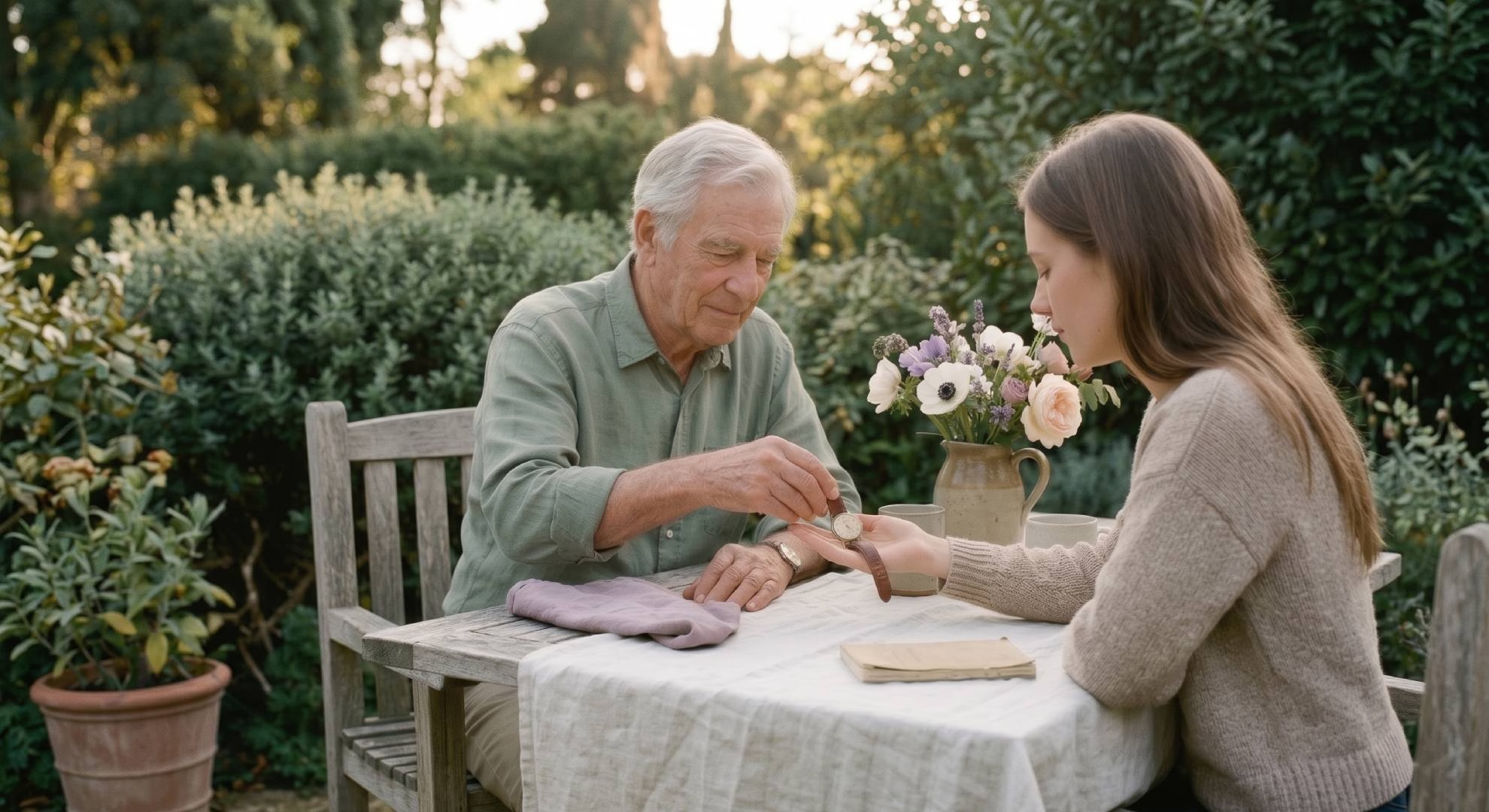


On a Tuesday afternoon in April, a retired machinist takes a socket wrench down from its hook in the garage and carries it into the kitchen, where his son-in-law is working on a slow drain. He does not make a speech. He says that the wrench has hung there long enough, that it belongs in a hand rather than on a hook, and that he would like it to go home with someone who will use it.
The son-in-law thanks him and sets the wrench on the counter, and the room goes briefly quiet. Everyone understands that something has happened, and no one is certain what to call it.
Scenes like this one occur in nearly every household where someone is approaching the end of life. A watch moves from a wrist into a grandchild’s palm. A recipe box, its cards soft with decades of flour and thumbprints, is pressed into a daughter’s hands on an ordinary afternoon.
None of it is announced, and almost all of it is remembered for the rest of the receiver’s life.
DISCLOSURE: This post contains affiliate links. When you purchase through these links, I may receive a small commission that helps me continue to provide these resources for your journey, at no extra cost to you. I only recommend resources I believe in.
The Gift Nobody Announces
A death doula who has spent time in many homes near the end of life learns to notice these small transfers early, often before anyone in the family has spoken the word dying. They tend to arrive without ceremony, tucked into an ordinary conversation, and they tend to be specific: this object, for this person, for a reason the giver may or may not say aloud.
The objects are rarely the valuable ones. A grandfather may leave his house and its contents to be divided by a lawyer, but the pocketknife goes to a boy who once asked how the blade folded. The choice is personal, and that is what separates it from housekeeping.
Timing matters less than families expect. Some people begin giving things away months before any diagnosis has been named, others wait until the last week, and still others never do. The absence of such gifts means nothing, and no family should read a silence on this subject as a failure of love.
It helps to be plain about what this behavior is and is not. Giving things away is a common and often early part of how people prepare for the end, but it is not a clinical sign and it predicts no date. It is a human act, and the person performing it is frequently the one in the room most at peace with it.
The Old Logic of the Gift
Anthropologists have long observed that a gift is never only an object. In his classic study of exchange across many societies, Marcel Mauss argued that what passes from giver to receiver carries something of the giver along with it, which is why a gift creates a bond and why it is so hard to receive casually.1
Annette Weiner later studied how societies treat certain possessions as carriers of identity and history across generations. She found that the handing on of such objects is among the weightiest things people do, because the object keeps speaking for the family long after the giver has gone.2
A watch or a recipe box is exactly this kind of thing. It is worth very little on a market, yet it holds a hand, a kitchen, a Sunday habit. When a dying person passes it on, a piece of that history is placed where it can keep working after the body cannot.
In many places, elders have handed on keepsakes while still living, sometimes with a ceremony and sometimes in the same offhand way as the wrench. The form changes from one culture to the next, and the belief underneath stays steady: an object given by a living hand is worth more than one found in a drawer.
Agency in the Final Season
Illness takes choices one at a time. Appointments, medications, meals, and even the hour of waking come to be set by other people, and a person who once decided everything about a household may find that the only decisions left are small ones.
Deciding where an object goes is one of the last large decisions that remains entirely a person’s own. It requires no permission from a care team and no form, and it can be done from a chair.
Sherry Turkle and her contributors, writing about the objects people think with, show how deeply an ordinary thing can become tied to a life, which helps explain why choosing its next home feels so weighty to the giver.3
There is a practical mercy in the act as well. A person who has chosen the recipient of a wedding ring spares the family an argument they might otherwise have in a hospital corridor. The giving thins the tether to the material world deliberately, one object at a time, and it leaves less for others to carry later.
It can also be love spoken in a language the giver finds easier than speech. A man who cannot say what his grandson means to him can say that the fishing reel should go to him. Families often notice a lightening in the giver afterward, as though a small weight has been set down.
Why the Receiver Flinches
The receiver often feels two things at once and cannot separate them. The gift is an act of trust and affection, and it is also, unmistakably, a farewell. Many people respond by deflecting, saying that the giver should keep it a while longer, or that there is plenty of time.
That response comes from love, and it can land as a door closing. The giver may hear that the subject is too frightening to discuss, and the object, still half offered, goes back on the shelf. A moment that might have carried a conversation about a whole life carries a small embarrassment instead.
Mihaly Csikszentmihalyi and Eugene Rochberg-Halton, in their long study of the things people keep in their homes, found that the objects people value most are those that link them to other people and to their own past.4 A family member who receives such an object is being handed a link rather than an item.
Discomfort is also the ordinary result of seeing the calendar. A gift of this kind quietly says that the giver has looked at the time remaining and made a plan, and the family has not yet agreed to look. A death doula does not ask anyone to feel differently, only to notice that both reactions are true.
Uneven gifts can complicate the picture. A sibling who hears that a brother received the watch may feel passed over, and a question that was never about the watch begins to surface. Naming the pattern early, and reminding everyone that the giver was following a personal memory rather than ranking affection, usually takes the heat out of it.
Where a Death Doula Steps In
A death doula can name what is happening in the plain words a family has not yet found. This is a person arranging a goodbye in the only form that feels natural, and the gift is the sentence they cannot yet say. Hearing that said aloud often loosens the room at once.
From there the work is mostly small and practical. A death doula can help a family receive an object well, suggesting that the receiver ask where the thing came from, what it was used for, and who held it before, so that the story travels with the object. The same questions give the giver a chance to say what the object has been carrying.
A death doula also listens for the tone of the giving. Most of the time it is warm, even light, with the giver enjoying the reaction. When it sounds flat, rushed, or desperate, a death doula slows down, asks gentle questions, and brings the concern to the family and the care team.
With the giver’s permission, a death doula can keep a quiet record of which object went where and why, which spares the family later confusion and honors the giver’s choices. For families who want someone beside them as these exchanges begin, a death doula’s steady presence in the final weeks offers a person who is not surprised by any of it.
The role has limits. A death doula does not decide who should receive what, does not referee a dispute among relatives, and does not offer legal advice about wills or property. When valuable items or contested heirlooms are involved, an estate attorney serves the family better, and a death doula says so plainly.
What a Family Can Do
The simplest response is to receive the gift fully. Say thank you, hold the object, and ask about it before saying anything else. A family member who has never been told what a tool was used for can ask, and the answer is often the best part of the gift.
It also helps to resist the urge to refuse. Saying that the giver will want it back, or should keep it for now, feels kind and tends to end the exchange. If an object truly is too much for the moment, the receiver can say so honestly and ask whether it might be kept together until the time is right.
Families can make the giving easier by asking, in a calm hour, whether there are things the person would like to see go to particular people. Some people have been waiting for permission to start, and they are relieved to be asked. A short written list, kept where everyone can find it, protects the person’s intentions without turning the afternoon into an inventory.
Photographs help more than most people expect. A picture of the giver holding the object, with a few lines about its story written on a card to be kept with it, turns a gift into a record. Years later, the card is often the thing a family treasures first.
Everything described so far assumes a person who is nearing the end of life, and that assumption carries real weight. Giving away possessions is a natural part of preparing for death when a person is very old or seriously ill, but the same behavior in someone who is not ill can be a sign of deep despair.
A death doula keeps that distinction in view, and families can do the same. If the giver is not facing a serious illness, or if the giving comes with hopelessness or talk of not wanting to be here, it deserves a gentle and direct conversation, and the involvement of a doctor or a crisis line such as 988 in the United States, right away.
In the far more common case, where age or illness is plainly part of the picture, the giving is one of several quiet changes in a household, because equipment arrives and furniture shifts to make room as well. A Death Doula Hears What the House Has Known follows that sequence room by room, and the two posts read well together.
The son-in-law finishes the drain. That evening he carries the wrench out to his truck and sets it on the passenger seat rather than in the toolbox, as though it might need company.
He will use it for twenty years. Each time his hand closes around that handle, the man who hung it in the garage will be a little closer than a photograph could manage, and the gift will turn out to have been the least final thing in the house.
What is the one object in your own home that you would hand to someone while you could still watch their face as they took it?
References
- Mauss, Marcel. “The Gift: The Form and Reason for Exchange in Archaic Societies”. Translated by W. D. Halls. New York: W. W. Norton, 1990. A classic study of why gifts carry the giver along with them and why receiving one creates a bond. ↩︎
- Weiner, Annette B. “Inalienable Possessions: The Paradox of Keeping-While-Giving”. Berkeley: University of California Press, 1992. An anthropological account of the objects families guard and hand on because they hold a shared identity and history. ↩︎
- Turkle, Sherry, ed. “Evocative Objects: Things We Think With”. Cambridge, MA: MIT Press, 2007. A collection of personal essays showing how ordinary things become bound up with a life. ↩︎
- Csikszentmihalyi, Mihaly, and Eugene Rochberg-Halton. “The Meaning of Things: Domestic Symbols and the Self”. Cambridge: Cambridge University Press, 1981. A study of the objects people value most in their homes and why those objects matter. ↩︎
Leave a Reply