

There is a moment, predictable and rarely discussed, in which the family of a newly deceased person is ushered into a room lined with caskets. The fluorescent light is neutral. The salesperson is kind, and their kindness is genuine.
The pressure, when it comes, arrives not as force but as implication: that love chooses the mahogany, that dignity is sealed with zinc, that care is measured in cubic inches of protective concrete. Most families accept this without question, not because they are passive, but because they have never been offered the alternative.
The alternative is older than the funeral industry by millennia. It is the unadorned body, wrapped or bare, lowered into the cherished earth and left to do what organic matter has always done in the dark and the damp.
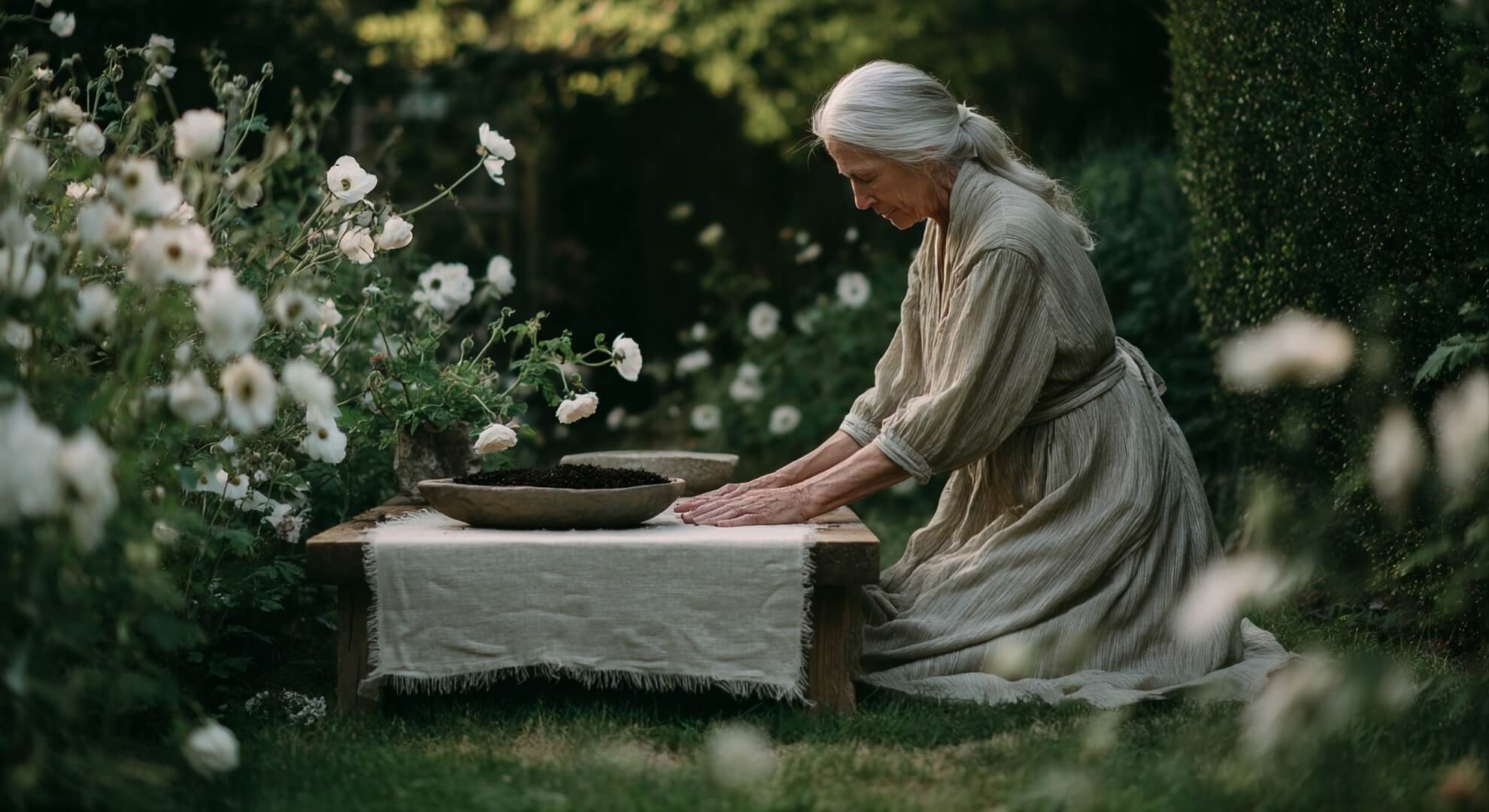
The green burial movement has a name now, and a growing legal architecture, and advocates who can walk families through every practical dimension of it. But its oldest advocates were simply the people who dug the graves. The death doula who stands with a family today, helping them think through what they actually want, occupies that same continuous line.
DISCLOSURE: This post contains affiliate links. When you purchase through these links, I may receive a small commission that helps me continue to provide these resources for your journey, at no extra cost to you. I only recommend resources I believe in.
The Unbroken Line Between the Living and the Ground
For the majority of human history, the preparation and burial of the dead was carried out by the community surrounding them. The body was washed by familiar hands, dressed in familiar cloth, and placed in the earth of a familiar landscape. There was no professional intermediary, no chemical preservation, no vault designed to resist the movement of soil and water.
This was not a failure of care. It was its most complete expression — the recognition that the body, which had been tended throughout a life, deserved the same attentiveness at its end. The earth received what the earth had always been receiving, and the family returned home altered by the work of their hands.
What ended this practice was not a decision but an accumulation: an industrializing society, the rise of professional undertakers following the Civil War’s mass casualties, and a marketing apparatus that successfully conflated embalming with hygiene.1 The intimacy of death preparation did not disappear because families rejected it. It disappeared because an industry organized itself around the assumption that families could not be trusted to do it.
What Green Burial Actually Encompasses
Green burial, in its simplest definition, is any burial that allows the body to decompose naturally without the intervention of chemicals, non-biodegradable materials, or concrete vaults. It is not a new category of product. It is the removal of layers of product that were never, before the mid-twentieth century, considered necessary.2
In practice, the term encompasses a range of choices. The body may be wrapped in a cotton or wool shroud and placed directly in the earth. It may be placed in a biodegradable casket of wicker, cardboard, or untreated wood. It may be interred in a conservation burial ground, where the land is protected by easement and the graves are unmarked by stone.
What these approaches share is a return of the body to the biological cycle it was always part of. Embalming delays decomposition for weeks or months; a sealed metal casket delays it further; a concrete vault delays it still further. None of these interventions stop decomposition. They merely postpone the return that was always coming, at the cost of the land, the chemistry, and the family’s sense that the farewell was honest.
Shroud Burial and the Intimacy of Cloth
The burial shroud is the oldest wrapping in the human record. Linen, wool, silk — the material has varied across culture and century, but the gesture has not: to enfold the body of someone you loved in fabric, as you might enfold a sleeping child, and to carry it to the place where it will be received.3
Shroud burial invites the family back into the preparation in a way that the conventional funeral explicitly removes them from. The body is bathed and dressed — often at home, often by the family themselves, with or without the guidance of a death doula — and then wrapped with the same attentiveness that was brought to every other physical act of care during the person’s life.
The intimacy of this is not for every family, and a skilled death doula does not advocate for it universally. What the death doula does is ensure the family knows it is available — that the choice exists, that it is legal in their jurisdiction, and that the physical realities of the process can be understood and prepared for before a decision is made under the pressure of acute grief.
Conservation Cemeteries and the Land That Holds the Dead
A conservation burial ground operates on a principle that runs counter to every assumption of the modern cemetery: the dead do not own the land; the land holds the dead. Graves in conservation grounds are marked, if at all, by native stones, plants, or GPS coordinates rather than engraved monuments. The land itself is held by easement, protected in perpetuity from development, and managed as a functioning natural habitat.4
The ecological argument for conservation burial is substantial. A single conventional burial deposits approximately two thousand seven hundred pounds of concrete, ninety-seven thousand tons of steel casket material, and eight hundred gallons of embalming fluid into the land annually across the United States. A green burial deposits none of these things, and instead returns organic material that enriches rather than burdens the soil.
For many families, however, the ecological argument is secondary to a simpler one: their person loved a particular landscape, and the idea of becoming part of it — literally, chemically, in the way that leaves and rainfall and the bodies of deer become part of it — carries a form of continuation that no marble monument can replicate.
Human Composting and What It Asks of the Living
Natural organic reduction — the process by which the body, combined with wood chips and plant material in a contained vessel, is transformed over several weeks into approximately a cubic yard of nutrient-rich soil — is the most recently named option in the green burial spectrum. It is also the one that most challenges the boundaries of existing emotional architecture.5
The difficulty is not practical. The process is well-documented, legally sanctioned in a growing number of jurisdictions, and results in a material that families can use to nourish a garden, a tree, or a piece of land with direct personal meaning. The difficulty is conceptual: the word “composting” carries domestic associations that seem, at first encounter, to jar against the dignity the family wishes to extend.
A death doula who has done their own thinking about what dignity actually requires — as opposed to what the funeral industry has trained us to assume it requires — can sit with a family through that initial reaction without rushing them past it. The question the death doula eventually helps the family ask is not whether this feels comfortable at first, but whether it reflects what the person who died actually valued, and what they would have chosen if the choice had been placed in front of them.
The Legal Landscape and What Families Are Not Always Told
The legal framework governing green burial in the United States, the United Kingdom, and much of Canada and Australia is more permissive than most families assume, and significantly more permissive than most funeral homes lead them to believe. Home burial — the preparation and burial of a family member on private property — is legal in the majority of American states, subject to setback requirements, depth specifications, and, in most cases, a death certificate and permit.6
What the law does not require, in most jurisdictions, is the involvement of a funeral home at all. It does not require embalming, a purchased casket, or a concrete vault. These things are marketed as requirements, or implied to be such, by an industry with significant financial interest in their purchase. The Green Burial Council, the Natural Death Centre in the United Kingdom, and state-specific family rights organizations have spent decades documenting the gap between what the law requires and what the funeral industry presents as obligatory.
The death doula who works with a family contemplating natural burial serves in part as an informed navigator of this landscape. A full outline of what that support looks like in practice, including the specific logistical guidance available to families at every stage of this process, is available through a dedicated page outlining death doula services.
The Industry That Arrived Between the Body and the Earth
The transformation of American burial practice from a domestic and communal event to a professional and commercial one occurred within approximately two generations. It was driven by forces that were partly economic, partly cultural, and partly the consequence of a genuine public health need — the management of battlefield casualties — that outlasted its original context.7
By the mid-twentieth century, embalming had been successfully marketed not as a practical convenience for families who needed to transport a body across distance, but as an act of love — and the un-embalmed body had been repositioned, subtly but effectively, as something that required professional management before a family could safely be in its presence. The casket showroom became the setting in which grief was converted into commerce, and the selection of protective materials became the metric by which devotion was measured.
Jessica Mitford’s dissection of this apparatus in the 1960s exposed the mechanisms without dismantling them, because the mechanisms were not sustained by ignorance alone.8 They were sustained by a cultural avoidance of death so thorough that most families found it easier to hand the body over than to remain with it — and by an industry that understood this avoidance with precision and organized itself around it.
The Death Doula in the Green Burial Choice
The death doula who helps a family navigate the green burial decision is doing something distinct from advocacy. Their role is not to argue for a particular choice, but to ensure that the choice being made reflects the genuine values of the dying person and their family rather than the path of least institutional resistance.9
This requires a form of information-sharing that is neither lecture nor sales pitch. The death doula holds the full range of available options — conventional burial, cremation, natural burial in its various forms — with equal steadiness, and helps the family understand not only the mechanics of each but the emotional texture of what each choice actually involves. The same attentiveness to the dying person’s actual values that characterizes trauma-informed end-of-life care applies with particular force here, where the family’s choice may diverge significantly from what the funeral industry has conditioned them to expect.
The practical contributions the death doula makes to a green burial can be substantial. They may guide the family with the preparation of the body at home, maintaining the composed and competent presence that allows family members to participate without becoming overwhelmed. They may coordinate with a conservation burial ground’s staff, help draft the documentation required for home burial, or guide the family through the process of selecting a shroud and understanding precisely how it is used.
Preparing the Family for What They Will Encounter
The decision to pursue natural burial requires that the family understand, in advance and with honest clarity, what a body does without intervention. This is not a conversation most families have had, because the funeral industry has organized itself around ensuring they never need to. It is a conversation the death doula is trained to have, and to have with care.
Without embalming, the body begins to change within hours of death. The rate and character of these changes depend on temperature, clothing, and the environment in which the body is held. For families who wish to spend time with the body at home before burial — which green burial generally encourages — this means understanding what they will see and smell over the course of one to three days, and what it means and does not mean about the condition of the person they loved.10
The death doula does not offer this information to discourage the choice. They offer it because a family that has been honestly prepared is a family that can remain present through the process without being blindsided — and presence, sustained through the discomfort of biological reality, is precisely the form of care that natural burial invites the family back into.
What the Earth Returns
There is a profound accounting that natural burial performs, one that no other contemporary death practice performs with the same directness. It asks the family to accept, without mediation or delay, what a body is made of and what it will become.
This acceptance is not resignation. It is recognition — the same recognition that led every human community before the modern era to involve itself directly in the preparation and interment of its dead. The body belongs to the earth, and the earth is not diminished by receiving it. The family that stands at a green burial, watching a shrouded figure lowered into soil, is witnessing something that has been witnessed a billion times across the length of human history.
What is new is only the choice — the deliberate act of reclaiming this witness from the institutions that absorbed it, and returning it to the people it belongs to. That act of reclamation is exactly what this blog post has argued for, in one form or another, across every subject it has addressed: that the end of life deserves the same quality of human attention as any other passage, and that the structures built to manage death at a distance are not the only option available to us.
The family that chooses natural burial chooses to stand close. And the death doula who stands with them honors, in that proximity, the oldest form of care there is.
If the land you loved throughout your life could receive your body at the end of it, and your hands and the hands of those who loved you could do the work of laying you in it, what would that form of farewell mean to you — and what would it ask of the people you leave behind?
References
- Laderman, Gary. “Rest in Peace: A Cultural History of Death and the Funeral Home in Twentieth-Century America.” An examination of how the professional funeral industry established itself in American life during the late nineteenth and early twentieth centuries, reshaping burial from a domestic community practice to a commercial service. ↩︎
- Harris, Mark. “Grave Matters: A Journey Through the Modern Funeral Industry to a Natural Way of Burial.” An investigative and narrative account of green burial options in the United States, tracing the full spectrum from conventional interment to home burial, conservation cemeteries, and decomposition-based alternatives. ↩︎
- Albery, Nicholas, Gil Elliot, and Joseph Elliot, eds. “The Natural Death Handbook.” A comprehensive practical guide to home-based death care and natural burial, including preparation of the body, legal requirements across jurisdictions, and the full range of biodegradable burial options available to families who choose to remain closely involved. ↩︎
- Kelly, Suzanne. “Greening Death: Reclaiming Burial Practices and Restoring Our Tie to the Earth.” A sociological study of the green burial movement, examining how conservation cemeteries operate, what ecological and emotional benefits they offer, and how the reclamation of natural burial intersects with broader cultural shifts in attitudes toward death and the environment. ↩︎
- Prothero, Stephen. “Purified by Fire: A History of Cremation in America.” A cultural history exploring how Americans came to accept cremation across the twentieth century, offering essential context for understanding how societies undergo fundamental shifts in their assumptions about body disposition and what those shifts reveal about evolving values. ↩︎
- Slocum, Joshua, and Lisa Carlson. “Final Rights: Reclaiming the American Way of Death.” A meticulously researched guide to consumer rights in the American funeral industry, documenting the legal permissions that families possess but are rarely informed about including the right to prepare a body at home and to purchase only the services they actually require. ↩︎
- Laqueur, Thomas W. “The Work of the Dead: A Cultural History of Mortal Remains.” A sweeping historical study of how human communities across centuries have treated their dead, tracing the development of burial practices, cemetery culture, and the evolving relationship between the living and the material remains of those they have lost. ↩︎
- Mitford, Jessica. “The American Way of Death Revisited.” The landmark and updated investigation into the American funeral industry, documenting the economic practices, marketing strategies, and institutional pressures that systematically removed families from direct involvement in the care of their dead. ↩︎
- Chapple, Helen Stanton. “No Place for Dying: Hospitals and the Ideology of Rescue.” An ethnographic study of how American hospital culture approaches the dying process, examining the institutional forces that remove agency from patients and families and the ways in which advocates including death doulas can work to restore it. ↩︎
- Roach, Mary. “Stiff: The Curious Lives of Human Cadavers.” A rigorously researched account of what happens to human bodies after death, providing the factual grounding that allows families and caregivers to approach the physical realities of dying and decomposition with informed equanimity rather than avoidance. ↩︎
Leave a Reply