

There is a particular kind of literacy that no school teaches and no professional credential certifies. It is not the literacy of medical charts or legal instruments, though those have their place. It is the literacy of mortality itself — the accumulated familiarity with death as a human fact, carried in the body and the imagination, that allows a person to remain upright when the ground beneath them gives way.
Most people do not possess it when they need it. They arrive at their first serious encounter with death — whether their own approaching end or the loss of someone irreplaceable — as beginners, confronting a landscape they have never visited in any rehearsal. The cost of that arrival is real, and it is borne at the worst possible moment.
A growing movement has decided that this is not inevitable. In community halls and tea shops, in borrowed basements and hospice meeting rooms, ordinary people gather to do something that contemporary culture has made quietly unusual: they talk honestly about death. They come not in crisis but in curiosity, not driven by urgency but by the considered conviction that the time to become familiar with what is coming is before it arrives.
DISCLOSURE: This post contains affiliate links. When you purchase through these links, I may receive a small commission that helps me continue to provide these resources for your journey, at no extra cost to you. I only recommend resources I believe in.
The Cost of Arriving Uninstructed
Most people encounter death for the first time as an emergency. The call arrives, the diagnosis is delivered, the ordinary afternoon fractures — and the person who must now navigate the most consequential terrain of human experience does so having had no instruction, no rehearsal, and no prior relationship with the territory at all.
This is not an accident of individual temperament. It is the predictable consequence of a culture that has organized itself, with considerable thoroughness, around the avoidance of the subject.
The deficit is not one of feeling. Grief, when it comes, arrives with overwhelming force regardless of preparation. What preparation offers is not immunity from that force but the capacity to remain upright inside it — to recognize what is happening, to understand that the disorientation is normal, and to know, at least in outline, what choices exist.
Without that prior education, even the most fundamental decisions of early bereavement must be made by people encountering their options for the first time while standing in the ruins of their previous life.
The psychologist Herman Feifel observed decades ago that Western culture’s refusal to engage with death as a normal subject had produced a population that was psychologically unprepared for the one event every member of that population would certainly face.1
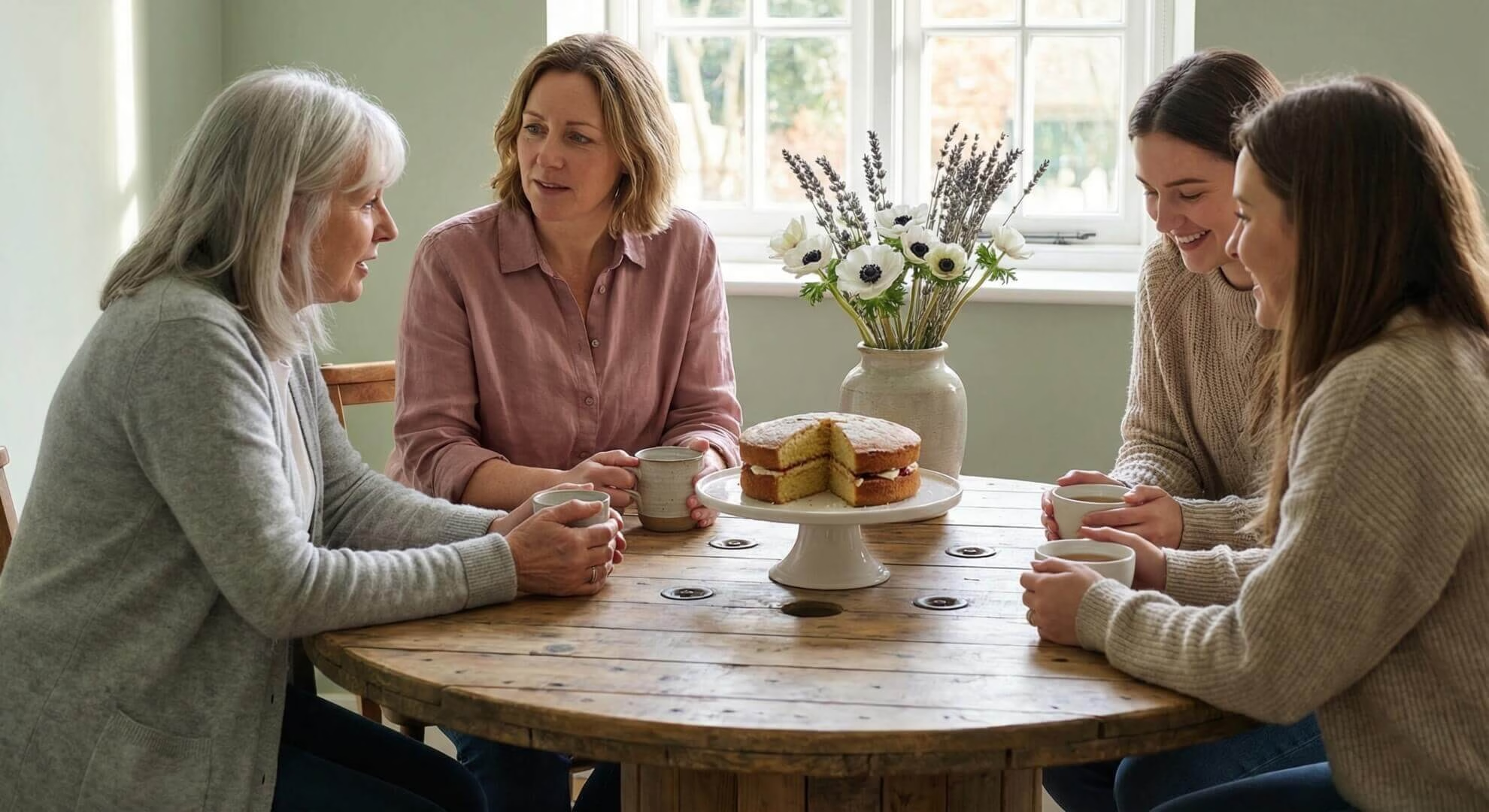
His observation has not aged. What has changed is that a small but growing number of people have decided to do something about it — not in therapy offices or hospital waiting rooms, but in tea shops, church halls, and borrowed community spaces, over slices of cake and cups of something warm.
What a Death Cafe Is and Is Not
A death cafe is not a grief support group. There is no clinical structure, no facilitator directing the conversation toward particular outcomes, and no assumption that the people who attend are in active crisis.
It is, in its most essential form, a gathering of people who have agreed to spend an hour or two talking honestly about death — their fears of it, their curiosity about it, the deaths they have witnessed, the deaths they anticipate, the questions they carry and have never found a suitable occasion to ask aloud.
The format is deliberately, almost defiantly ordinary. There is food. There is something to drink. The setting is chosen for comfort rather than gravity, and the atmosphere is one of invitation rather than obligation. Anyone may attend, anyone may speak, and anyone may also simply listen — the only requirement being a willingness to be in a room where the subject is not going to be changed.
What this produces is stranger and more valuable than it sounds on paper. A room full of strangers who have agreed to speak honestly about mortality turns out, almost invariably, to generate precisely the kind of conversation that the same individuals have been unable to have with their closest friends and family members for years.2
The permission, it seems, was the missing element.
The Origins of an Ordinary Movement
The death cafe movement traces its formal origins to 2011, when Jon Underwood organized the first gathering in the basement of his home in Hackney, London, drawing on the concept of the cafe mortel developed by the Swiss sociologist Bernard Crettaz a decade earlier.
Underwood’s contribution was to strip the model of institutional affiliation and make it available to anyone who wanted to host a gathering — free of charge, without organizational oversight, and without any agenda beyond the conversation itself.
The simplicity of the model proved to be its most powerful feature. Death cafes cannot be franchised or monetized in any meaningful way, because their value resides entirely in the quality of the conversation among the people in the room. What Underwood designed was not a service but a permission structure — a recognized social form that gave people who wanted to talk about death a legitimate occasion to do so.3
By the time of Underwood’s own death in 2017, at the age of forty-four, death cafes had been held in more than fifty countries. The movement continued without institutional direction, carried forward by individual hosts who had discovered that hosting such a gathering was, for many of them, among the most meaningful things they had done.
Why Cake and Tea Are Not Incidental
The presence of food at a death cafe is not decorative. It is structural. Food at a gathering signals that what is happening is social rather than clinical, communal rather than therapeutic, and that the comfort of the body is considered relevant to whatever is being attempted.4
The cup of tea in the hand reduces the formality of the occasion and removes the pressure to perform at the level that a seminar or a support group might seem to require.
This matters because the barrier to speaking honestly about death is primarily social rather than psychological. Most people, if asked in the right setting by the right dialog partner, are willing to engage with the subject directly and sometimes at considerable depth.
The difficulty is not access to the material. It is that the social occasions on which the subject is welcome have become vanishingly rare, and the ordinary cues for such conversations have largely disappeared from contemporary life.
The tea and the cake are those cues, reconstructed. They signal that the conversation about to take place is continuous with the rest of human social life rather than exceptional to it — and this continuity is precisely what allows people who would never describe themselves as preoccupied with mortality to discover that they have, in fact, a great deal to say.
What Gets Said Over Cake
No two death cafes produce the same conversation, which is by design. The absence of a facilitator-directed agenda means that what surfaces is what the particular group of people in the room actually needs to say.
Across tens of thousands of gatherings on six continents, certain themes recur with enough consistency to constitute a kind of unofficial curriculum of human mortality concerns.
Fear of pain and physical diminishment appears early in most conversations, followed closely by the question of whether a life has accumulated the meaning its length seemed to promise.
There is discussion of what should be said to people who are dying — and, more urgently, what should be said now, while the occasion has not yet arrived and the people in question are still available to receive it.
There are questions about what happens to the body, about what the dying process actually involves, and about the bureaucratic and logistical landscape that falls to families in the aftermath of a death.5
What happens in this conversation is not the same as what happens in formal education about end-of-life planning. The information exchanged is often significant, but it is the experience of having exchanged it — of having sat with strangers who turned out to share one’s own unspoken preoccupations — that constitutes the primary value.
Participants consistently report leaving death cafes feeling less alone in their mortality than when they arrived.
The Death Doula as a Guide to Death Literacy
The death doula and the death cafe inhabit the same cultural territory without being the same thing. Both are responses to the same fundamental problem: that contemporary society has privatized death so thoroughly that individuals arrive at its threshold without the knowledge, the language, or the emotional preparation to navigate it.
Where the death cafe builds literacy through community conversation, the death doula builds it through individualized accompaniment — offering the kind of sustained, personalized guidance that a community gathering cannot provide and was never designed to.
For many people, a death cafe represents the first occasion on which the subject of mortality has been treated as a legitimate topic of conversation rather than a thing to be managed or deflected. It opens a door.
What the death doula offers is the capacity to walk through that door with a knowledgeable companion who can address the specific questions, fears, and circumstances that belong to a particular life rather than to the general category of human mortality. The full range of support available in that accompaniment is outlined on our services page.
A death doula who attends or hosts death cafes is doing something distinct from providing professional end-of-life care. They are participating in the cultural work of normalizing the conversation — lending their knowledge and presence to a community gathering without converting that gathering into a professional context. This distinction matters.
The value of the death cafe lies precisely in its non-professional, non-clinical character, and a death doula who understands this can contribute to the space in a way that enriches rather than medicates it.
What Death Literacy Actually Produces
Death literacy is a term that appears with increasing frequency in the academic literature on end-of-life care, most prominently in research examining how communities can build collective capacity to care for their dying.6
The concept is deceptively simple: the knowledge, skills, and social connections that allow individuals to support themselves and others through the experience of dying and death — not the specialized knowledge of medical professionals, but the functional literacy of an informed adult who knows what is available, what their options are, and what questions to ask.
The evidence that this literacy matters is substantial. Individuals with higher death literacy make more informed decisions about advance care planning, engage more effectively with the medical system on behalf of dying relatives, and experience less traumatic bereavement in the aftermath of loss.
They are more likely to have had the conversations with family members that prevent the anguish of post-death uncertainty, and less likely to be ambushed by the practical and administrative demands of early bereavement at the moment when those demands are most difficult to meet.
What death cafes contribute to this literacy is harder to quantify but no less real. They normalize the subject. They build the social vocabulary that makes it possible to speak about mortality with precision and without panic. They demonstrate, repeatedly and in the most ordinary of settings, that the topic can be raised, discussed, and set aside again — that the conversation does not open an abyss but simply acknowledges one that was already there.
The Education That Precedes the Need
There is a quality of attention available to a person who has been thinking about death for years that is simply unavailable to a person encountering it for the first time. This is not a function of courage or equanimity. It is a function of familiarity. The terrain, however difficult, has been walked before in the imagination, and the walker has accumulated a sense of its dimensions.
This prior familiarity does not insulate a person from grief. Nothing insulates a person from grief. What it provides is a framework within which grief can be understood as a predictable response to a universal event rather than as an incomprehensible catastrophe with no precedent in one’s experience.
The difference in how a crisis is metabolized by someone who held that framework and someone who did not is, in the testimony of bereaved people and the clinicians who work with them, consistently and significantly large.
The education that begins at a death cafe is real education, even when it does not feel like it. The person who attended three death cafes over the past two years and came away with no particular conclusions — no decisions made, no documents signed, no formal plans laid — has nonetheless been building the kind of relationship with mortality that will serve them when the need arrives.7
The conversations happened. The vocabulary was acquired. The fact of having been in a room full of people speaking honestly about death left a residue, and that residue is literacy.
An Invitation to Begin
The death cafe asks almost nothing of the people who attend it. There is no commitment required, no expertise expected, and no particular emotional state that one must bring or achieve. There is only the premise that the subject is one worth bringing into ordinary human life — that speaking about mortality before the urgency of crisis forecloses the luxury of reflection is both possible and worthwhile.
What most people discover, when they sit down with their tea and their cake and their willingness to spend an hour inside the subject, is that the conversation was not the thing they were afraid of. The fear was of the subject itself — the cold weight of finality, the specific losses that such a conversation might be understood to anticipate.
The conversation turns out to be something else: companionable, sometimes even light, shot through with the particular relief that comes from saying aloud what has been carried in silence.
The most merciful thing a person can do for the self they will eventually become — the one who will receive a call, or sit in a waiting room, or stand at a graveside — is to become, right now, in the ordinary fullness of a life still in possession of its faculties, a little more fluent in the language of what is coming.
A death cafe is a place to begin that fluency. It is not a preparation for death. It is a preparation for living with greater honesty about what life contains.
For those exploring what a broader engagement with death literacy looks like in individual practice, the post What a Death Doula Knows About Leaving Love Behind addresses the related work of intentional legacy creation — the deliberate act of recording values, memories, and love before the opportunity is foreclosed. The two practices share a common root: the refusal to defer what matters until it is too late to do it well.
The tea is already on the table somewhere. The conversation has already begun, in a room not far from where you are. What would it mean to you to walk into that room — not because a crisis has arrived, but because you have decided, in advance and by choice, to become someone who knows how to speak about what is coming?
References
- Feifel, Herman, ed. “The Meaning of Death.” McGraw-Hill, 1959. A foundational collection challenging Western culture’s institutional avoidance of mortality. ↩︎
- Howarth, Glennys. “Death and Dying: A Sociological Introduction.” Polity Press, 2007. A sociological survey examining how the privatisation of dying has altered social relations and the collective capacity to support the dying and bereaved. ↩︎
- Seale, Clive. “Constructing Death: The Sociology of Dying and Bereavement.” Cambridge University Press, 1998. An analysis of how social structures and cultural norms shape the way death is understood, spoken about, and organised in modern societies. ↩︎
- Metcalf, Peter, and Richard Huntington. “Celebrations of Death: The Anthropology of Mortuary Ritual.” Second edition. Cambridge University Press, 1991. A comparative anthropological study of how communities use ritual to process death. ↩︎
- Corr, Charles A., Clyde M. Nabe, and Donna M. Corr. “Death and Dying, Life and Living.” Wadsworth Publishing. A widely used framework for understanding the practical, psychological, social, and spiritual dimensions of death education. ↩︎
- Elias, Norbert. “The Loneliness of the Dying.” Translated by Edmund Jephcott. Blackwell, 1985. A penetrating sociological essay on how modern Western societies have progressively isolated the dying from their communities. ↩︎
- Papadatou, Danai. “In the Face of Death: Professionals Who Care for the Dying and the Bereaved.” Springer, 2009. A nuanced examination of how sustained exposure to mortality shapes knowledge, emotional capacity, and relational attentiveness. ↩︎
Leave a Reply