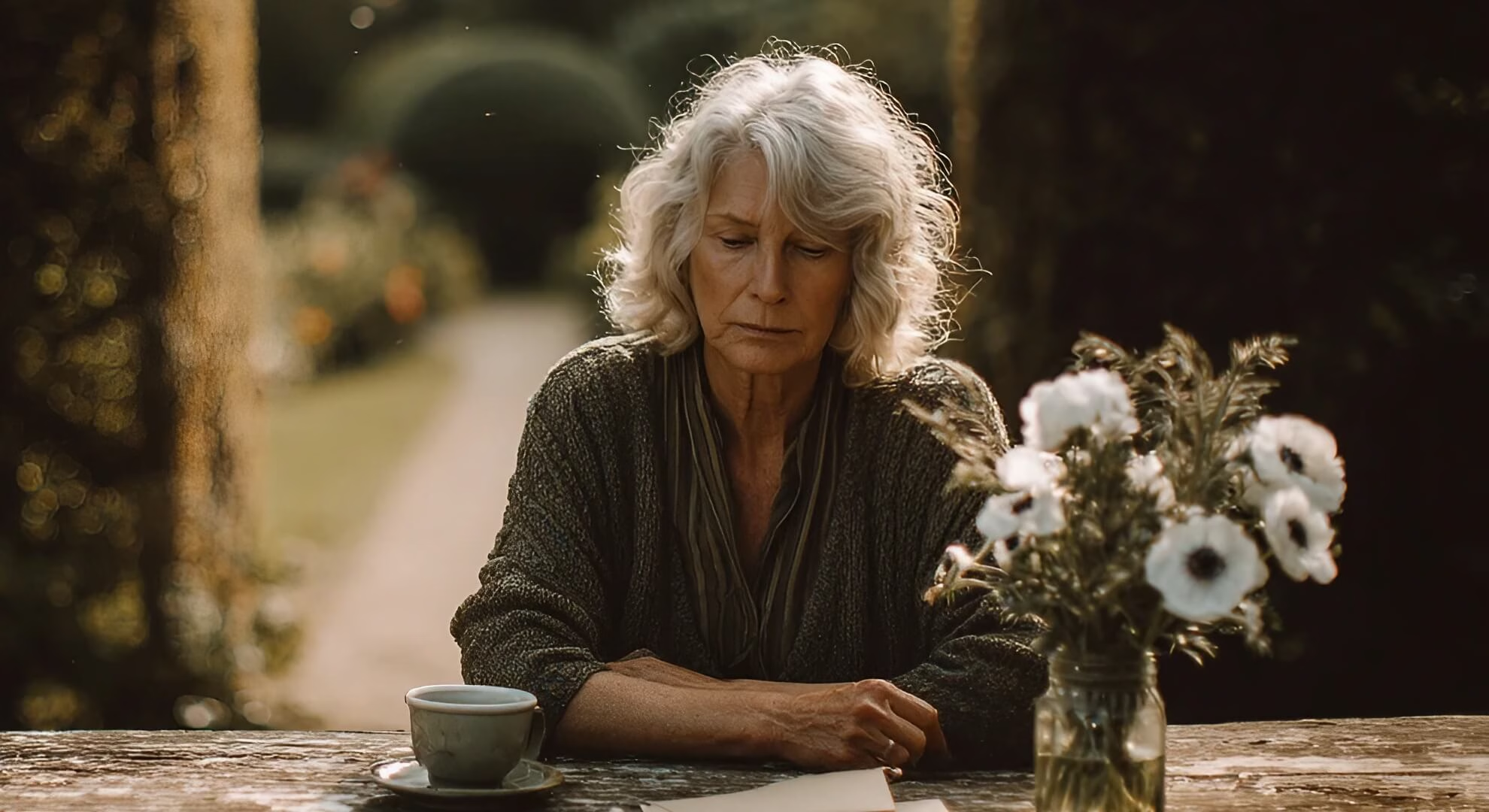


The last conversation happened seven years ago, in a parking lot, and it ended badly. Since then, there has been silence — not the silence of resolution but the silence of a question that neither side returned to answer. The dying person is in a hospital three states away, and the estranged family member holds a phone that has not rung.
What they feel in this moment is not what the word “grief” was designed to describe. It is something more compound and more strange: a sorrow folded inside anger folded inside guilt folded inside the particular vertigo of not knowing whether they are even permitted to feel anything at all.
The phone may eventually ring, or it may not. The estranged family member may make it to the bedside, or they may not. What is nearly certain is that the ordinary architecture of bereavement — the rituals, the condolences, the vocabulary of loss — was not built for them, and they will discover this at the worst possible time.
DISCLOSURE: This post contains affiliate links. When you purchase through these links, I may receive a small commission that helps me continue to provide these resources for your journey, at no extra cost to you. I only recommend resources I believe in.
The Grief That Arrives Without Credentials
When bereavement researchers began cataloguing the forms of grief that existing support structures fail to recognize, they identified a pattern that had no clinical name but was recognized immediately by anyone who had experienced it.
It is the grief of the person whose loss cannot be publicly mourned, whose relationship to the deceased is deemed — by themselves, by others, or by both — as insufficient to justify the depth of what they feel.1
The estranged mourner is among the clearest examples of this phenomenon. They arrive at a death carrying a relationship that the world did not witness in its final chapter, and they often find that the world’s response to their loss mirrors the estrangement itself: distant, uncertain, and unwilling to fully commit to acknowledgment.
What compounds this is the internal tribunal. Before any external judgment arrives, the estranged person has already put their own grief on trial, questioning whether they have earned the right to mourn someone they chose, or were forced, to leave.2
What Estrangement Actually Is — and Is Not
The public narrative of estrangement tends to organize itself around two poles: the villain parent who drove their child away, and the ungrateful adult child who abandoned a devoted family. Neither pole is adequate to the reality, and neither serves the people who must navigate the end of life across this specific terrain.
Research on family estrangement has consistently found that the causes are heterogeneous, that both parties typically hold complex and often contradictory accounts of what happened, and that the experience of estrangement is rarely static — it shifts across years, reopens around life events, and is rarely as resolved as it appears from the outside.3
The person who has not spoken to a parent in a decade may still carry that parent’s voice in their internal life with considerable force. The sibling who cut contact after an inheritance dispute may grieve the sibling they once had — not the one they left — with a thoroughness that surprises them.
Estrangement is not the same as indifference. It is often its precise opposite: a relationship so charged with significance that continued proximity became impossible to sustain.
The Dying Person Who Caused the Harm
When the estrangement is rooted in harm — when the dying person was abusive, neglectful, or a source of damage whose effects the surviving person is still living with — the approach of their death creates a particular moral and emotional collision.
The person who was harmed is now expected, by some ambient cultural assumption, to set aside that harm in recognition of the dying. This expectation is rarely spoken aloud. It arrives in the form of implication, in the eyes of siblings who made a different choice, in the question of whether to attend.
What this expectation fails to account for is that the harm does not relocate because the person who caused it is dying.4 The child who was treated cruelly does not owe their parent a deathbed reconciliation. The adult survivor of family violence does not owe the dying person a presence that would compromise their own stability.
These are not failures of love or generosity — they are honest assessments of what a particular relationship was and what it was not.
A death doula who enters this territory does not adjudicate the history. Their task is to hold the survivor’s experience exactly as it is — without nudging it toward forgiveness, without implying that a visit is necessary for the survivor’s own healing, and without importing any agenda about what a good ending should require.
The Siblings Who Chose Differently
Estrangement rarely occurs in isolation within a family system. More often, it distributes itself unevenly: one sibling maintains contact, another cuts it; one absorbs the caregiving burden, another lives at a deliberate distance from it.5 The dynamics this creates are among the most complicating features of estranged grief.
The sibling who remained close to the dying parent may experience the estranged sibling’s absence as an abandonment — of them, not merely of the parent. They have been carrying a weight that was shared unevenly, and the approach of death tends to make the distribution of that weight feel more rather than less unjust.
The estranged sibling, meanwhile, watches from a distance as a family narrative organizes itself around their absence, and understands that whatever they feel will be measured against the choices made by the sibling who stayed.
The death doula who works with families navigating this configuration must hold all of these positions simultaneously — without triangulating, without validating one account at the expense of another, and without allowing the family’s unresolved conflict to redirect attention away from the dying person’s actual needs.
What Only a Death Doula Can Hold
The estranged mourner is not well-served by conventional grief support in the immediate aftermath of a death. Grief groups assume a loss that others recognize. Therapeutic frameworks, however skilled, operate across time and through a clinical container that the urgency of early bereavement does not always permit.
What the estranged person needs in the days and weeks immediately following the death is something more direct: a companion who will neither minimize the ambiguity of what they are feeling nor require them to simplify it before it has been fully examined.
This is the specific kind of presence the death doula is trained to provide — not a directive toward healing or a framework for processing, but a steady witness whose task is to make the room large enough to hold what is actually there. The death doula does not arrive with an agenda about what the mourner should be feeling or where their grief should be directed. They arrive with the capacity to stay.
For those who are uncertain what this accompaniment looks like in practice — whether before or after the death — a full account of available support is outlined on the services page.
The Permission That No One Can Grant
Among the most persistent and damaging features of estranged grief is the search for external permission to mourn. The estranged person looks to the family who remained, to the funeral rituals in which they may feel unwelcome, to the social scripts of bereavement that do not accommodate their situation — and finds that the permission they are seeking is unavailable from any of these sources.
This is partly because the concept of grief permission is itself a misdirection. Permission to mourn is not a thing another person can bestow. It is a capacity the mourner must locate within themselves — and the obstacle is not a lack of entitlement but a deeply internalized narrative about what the relationship was worth.6
The estranged mourner who believes, at some level, that they forfeited the right to grieve by leaving has conflated the choice to protect themselves with a moral failure, and is punishing themselves for a decision that may have been among the most self-respecting choices of their life.
A death doula who works skillfully in this territory does not offer reassurance that the grief is legitimate. They do something more substantive: they sit inside the grief with the mourner until the mourner can feel, from the inside, that it is real.
The Conversation That Will Not Now Occur
One of the defining features of estranged loss is the finality it imposes on questions that the living relationship had at least theoretically left open. While the estrangement persisted, there was always the possibility — however remote, however exhausting to contemplate — that something might change.
The dying person might acknowledge what they did. The rift might be bridged in some form that neither party had yet managed. That possibility, however attenuated, was a form of continuation.
Death forecloses it entirely. The estranged mourner must now grieve not only the person but the conversation that will not now occur — the account that will never be given, the acknowledgment that will never arrive, the version of the relationship they never managed to inhabit.7
This is a specific and under-acknowledged loss, and it does not organize itself according to the stages or sequences that conventional grief frameworks supply.
The death doula who accompanies an estranged mourner through this particular passage holds space not only for the death itself but for all the losses nested inside it: the lost possibility, the lost version of the person, the lost chance at whatever resolution might have meant.
What the Relationship Was
The measure of a relationship is not its final state. An estrangement of ten years does not retroactively erase the preceding twenty. The daughter who cut contact with a harmful mother at thirty-five still carries the mother of her childhood — the voice, the history, the specific texture of what was present before the harm became impossible to absorb. Both are real. Neither cancels the other.
The death doula who works with estranged mourners returns, again and again, to this complexity — not to produce a reconciled narrative where none exists, but to resist the reduction that grief under pressure can impose. The loss is not simple, because the relationship was not simple, and any account that simplifies it will eventually break under the weight of what it excludes.
What the death doula ultimately offers is not resolution. It is accurate companionship — a presence that can hold the full, ungainly, irreducible truth of what the relationship was, and remain steady inside it without requiring it to become easier than it is.
For those navigating the specific challenge of a dying person who has declined to acknowledge the approaching end — a dynamic that frequently intensifies in families already fractured by estrangement — the earlier piece When Death Goes Unspoken, a Death Doula Stays addresses how a death doula holds a household in which the central truth cannot be named aloud.
What would it mean to be accompanied through the aftermath of an estranged death by someone who does not require you to simplify what you feel — who holds both the grief and the grievance without asking you to choose between them?
References
- Pillemer, Karl. “Fault Lines: Fractured Families and How to Mend Them.” Avery, 2020. A sociological and psychological study of adult family estrangement drawing on hundreds of in-depth interviews, examining why estrangements form, how they persist, and what they cost both the estranged and those who remain. ↩︎
- Scharp, Kristina M. “Making Meaning of Estrangement in the Adult Child–Parent Relationship: A Constructivist Grounded Theory Investigation.” Journal of Social and Personal Relationships 33, no. 6 (2016): 805–820. A qualitative study examining how adult children construct and communicate the meaning of their estrangement, revealing the fluidity, ambivalence, and complexity that fixed popular narratives of estrangement typically suppress. ↩︎
- Herman, Judith. “Trauma and Recovery: The Aftermath of Violence — From Domestic Abuse to Political Terror.” Basic Books, 1992. A foundational clinical study of complex trauma and its relational aftermath, establishing that recovery from harm requires acknowledgment and that the healing of survivors is not contingent on the behavior or status of those who caused the harm. ↩︎
- Bowen, Murray. “Family Therapy in Clinical Practice.” Jason Aronson, 1978. A foundational text in family systems theory tracing how emotional patterns, relationship triangles, and differentiation dynamics operate across generations, with particular relevance to understanding how estrangement distributes itself unevenly within a sibling group. ↩︎
- Corr, Charles A. “Enhancing the Concept of Disenfranchised Grief.” OMEGA — Journal of Death and Dying 38, no. 1 (1998–99): 1–20. An expansion and deepening of the framework for grief that existing social structures fail to recognize or support, with direct application to mourning that occurs outside the boundaries of socially sanctioned loss. ↩︎
- Pennebaker, James W., and Janel D. Seagal. “Forming a Coherent Story: Benefits of Narrative.” Journal of Clinical Psychology 55, no. 10 (1999): 1243–1254. A research-based examination of how constructing a coherent personal narrative around difficult experience produces measurable psychological benefit and enables the mourner to move from fragmented feeling toward integrated understanding. ↩︎
- Rubin, Simon Shimshon. “The Two-Track Model of Bereavement: Overview, Retrospect, and Prospect.” Death Studies 23, no. 8 (1999): 681–714. A clinical model of bereavement that tracks both functional adaptation and the ongoing relational bond with the deceased, providing a framework for understanding how mourning an estranged person involves the simultaneous processing of the death itself and the relational history that preceded it. ↩︎
Leave a Reply