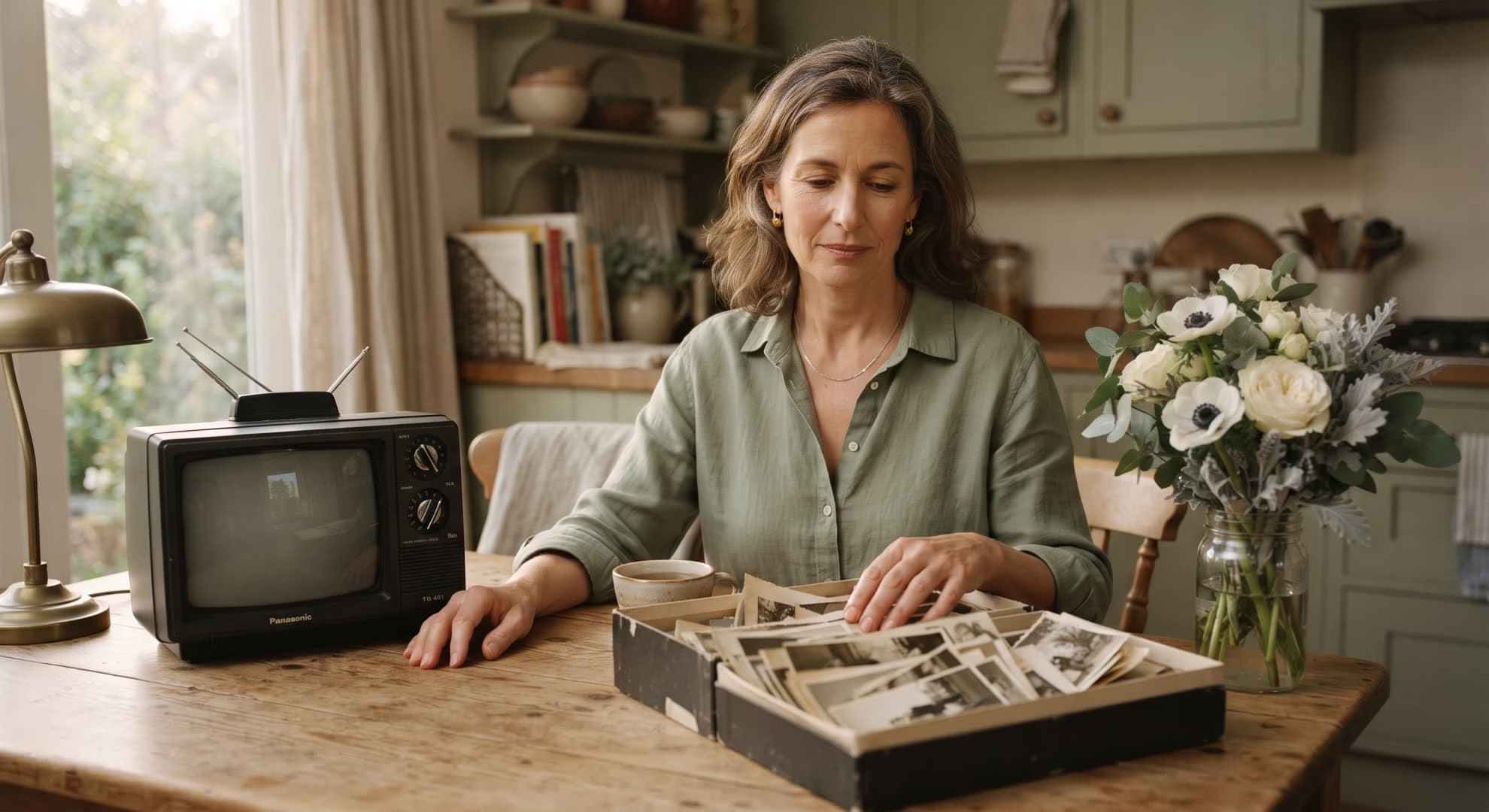


In 1988, in a modest house, an aunt closed the door to the room where a grandfather was dying and did not open it again until the breathing changed. The neighbors brought a casserole and did not ask to come inside. The children in that house were sent to a corner with crayons and told, gently, that everything was fine.
It plainly was not fine, and the quiet management of it was itself the lesson. Dying happened privately, behind a closed door, tended by people who knew the dying man’s name.
Thirteen years later, some of those same children sat in a school cafeteria or a college common room and watched two towers fall, live, on every channel at once. They watched it again that afternoon, and the next morning, and for years afterward in replay footage that arrived unsolicited on anniversary broadcasts.
This is the specific inheritance of the generation born roughly between 1977 and 1985, sometimes called Xennials for lack of a tidier label. Their childhood was formed inside the last fully private era of American dying. Their adulthood was formed inside the first fully public one.
A death doula who works with this cohort is working with two languages of mortality at once, and neither one explains the other.
DISCLOSURE: This post contains affiliate links. When you purchase through these links, I may receive a small commission that helps me continue to provide these resources for your journey, at no extra cost to you. I only recommend resources I believe in.
The Last Generation to Bury Death at Home
Before the final decades of the twentieth century, dying in America was still, in the ordinary case, a domestic event. A person declined at home, was tended by relatives and neighbors, and was mourned inside a house that continued to hold the rest of the family’s daily life.
The historian Julie-Marie Strange has documented how thoroughly working households absorbed death into their existing rhythms, treating the dying room as one more room in active use rather than a space set apart.1
Xennial children, born into the tail end of this arrangement, absorbed its logic without ever being taught it directly. Death was slow. Death was local, and it was managed by people whose faces they recognized, in rooms whose smell they would remember for decades.
What they were not given, in most cases, was direct proximity to the dying itself. The door still closed, and the actual moment of death remained, for a child, mostly invisible.
The surrounding architecture, though, belonged to a private, analog choreography that the sociologist Geoffrey Gorer once described as a culture still willing to let death be seen and spoken of, even if only at its edges.2 Casseroles arrived. Telephones were answered in hushed voices, and a funeral home van idled at the curb long enough for a curious child to notice it and then be steered gently away.
This was not a generation encouraged to speak openly about what was happening in the back bedroom. It was, instead, a generation trained in a particular kind of watchful patience, the sense that grief was a household weather system that adults managed on a schedule children were not told.
That patience became a skill. It is the same skill many of these adults now recognize in themselves at a parent’s bedside decades later, the instinct to lower the voice, close the door partway, and let the dying proceed on its own unhurried timetable.
Then the Screens Arrived
That choreography did not survive the decade that followed. Cable news matured into a permanent, always-on medium precisely as this generation entered adolescence and early adulthood, and the deaths it began broadcasting were not slow, local, or tended by anyone the viewer knew.
September 11th, 2001, arrived as the sharpest single hinge. Psychologists who study flashbulb memory, the vivid and often permanent recall attached to a shocking public event, have found that such memories are encoded with unusual force precisely because they are witnessed collectively, in real time, by people who have no personal relationship to what they are seeing.3
For Xennials, that hinge fell at a specific developmental moment. They were old enough to understand exactly what they were watching and young enough that the images lodged permanently, alongside the older, private template their childhoods had already built.
The two templates did not replace one another. They simply began to coexist, unreconciled, inside the same nervous system, and they have been coexisting there ever since.
Two Cohorts Meeting Inside One Body
Most generational writing about death treats a cohort as though it holds one relationship to mortality. Xennials complicate that assumption because they are, in this narrow but significant sense, two cohorts occupying a single body: the child who learned death as intimacy, and the young adult who learned it as spectacle.
This double formation produces a specific kind of disorientation when an actual dying person finally enters the room. Some Xennials arrive at a parent’s bedside braced for scale and emergency, scanning for the wrong kind of danger, because that is the register their adult formation trained into them.
Others arrive expecting the hushed, managed privacy of childhood and are unsettled by how exposed modern hospital dying can feel, with its beeping monitors and shift-changing strangers. The mismatch between what they braced for and what they encountered can feel, in the moment, like a personal failure of composure.
Neither reaction is a failure of preparation. Both are the predictable result of having been handed two different instruction manuals for the same event, written twenty years apart, and never told that only one of them would need to be used at a time.
Consider the Xennial daughter who finds herself checking her phone compulsively in a hospice hallway, refreshing news alerts unrelated to the room she just left, unable to explain the impulse even to herself. It is not distraction in any ordinary sense.
It is the adult template, formed in front of a screen, reaching for the only mechanism it ever learned for metabolizing a mortal event: watching, refreshing, staying informed. The childhood template has no comparable mechanism to offer, because it was never asked to process anything in real time at all.
What Neither Register Prepares You For
Research on cumulative exposure to collective trauma has found something counterintuitive: repeated exposure to mediated catastrophe does not build tolerance. It builds sensitivity.
Adults with a longer history of absorbing public traumatic events through media have shown measurably stronger acute stress responses to new ones, regardless of physical proximity to any of them.4
For the Xennial arriving at a parent’s decline in midlife, this sensitization compounds an older and quieter expectation, absorbed in childhood, that death is supposed to be contained, private, and manageable inside four walls. The dissonance is not that the adult formation overwhelms the childhood one.
It is that the childhood one keeps insisting the room should feel smaller and calmer than the adult formation has ever taught this person a room can feel. The two registers argue with each other in real time, at the worst possible moment, over what the correct emotional response even is.
The result, often, is a caregiver who is simultaneously hypervigilant and quietly ashamed of the hypervigilance, certain that a calmer relative from a different generational position would be handling the same bedside with more composure. That certainty is rarely accurate, and it is almost never kind.
Where a Death Doula Meets Both
A death doula working with a Xennial family is rarely working with a person who lacks a relationship to mortality. The opposite is closer to the truth. This is a person carrying two full, well-formed relationships to death that were never given the chance to negotiate with each other.
The death doula’s first task is often simply naming that duality aloud. Once a family member hears that the disorientation they feel has a coherent explanation, rooted in the specific decade and media environment of their formation rather than in some personal deficiency, the shame that so often accompanies caregiving hypervigilance tends to loosen its grip considerably.
From there, the death doula can do something neither the childhood template nor the adult one could do alone: build a room that borrows the best of both.
The slow, tended, name-known intimacy of the analog inheritance can be restored to the bedside even inside a modern hospital, through unhurried presence, familiar music, and the deliberate slowing of pace that a death doula is trained to bring.
At the same time, the death doula can hold the hypervigilance that mediated death instilled without treating it as pathology. It is an old alarm system that has been ringing since adolescence, and it does not need to be silenced so much as it needs a quieter signal to finally answer to.
For families who recognize this particular tension in themselves, working with a death doula offers a companion who has thought carefully about exactly this collision, rather than a well-meaning visitor who assumes one grammar of dying is simply correct and the other a distortion to be corrected.
What This Generation Can Do Now
Naming the duality is useful before a crisis arrives, not only during one. A Xennial adult who recognizes that they are carrying two inherited templates for death can begin to notice, in advance, which one tends to activate first under stress, and can share that pattern with whoever else will be present at a future bedside.
It also helps to revisit, deliberately, what the childhood template actually offered. The closed door and the casserole were not merely avoidance.
They represented a form of communal tending that many modern families, scattered and thinned by distance, no longer have in place. Part of preparing well is asking, honestly, who might still be recruited to rebuild a version of that tending before it is needed.
The companion piece Death Doulas Meet the Generation That Watched Too Much Die observes the adjacent experience of the slightly younger cohort whose primary formation was televised death rather than a private one that came first.
Reading the two pieces together clarifies how much a handful of birth years can change the shape of a generation’s relationship to mortality.
The Reconciliation That Becomes Possible
There is real relief available to the Xennial caregiver once the two inherited grammars are named rather than left to silently compete. The hypervigilance does not need to be defeated.
It needs only to be recognized as one voice in the room rather than the only one, so that the older, quieter voice, the one that learned death as something tended by familiar hands in a familiar house, can also be heard. Both voices, it turns out, were paying attention to something real.
What emerges, when both voices are allowed to speak, is not confusion but a fuller instrument. The generation that watched the towers fall also remembers what a closed door and a casserole meant, and both memories, held together rather than at war, turn out to be closer to what an intimate death actually requires than either memory alone.
The aunt who closed the door in 1988 could not have known what her nephews and nieces would watch, thirteen years later, on every channel at once. She was simply doing what her own inheritance had taught her: that dying belonged inside the house, tended quietly, by people who knew the name of the person in the bed.
Her nephews and nieces inherited that lesson and then were handed a second one, unrequested, in a school gym or a living room, in real time, on a Tuesday morning. They have been carrying both ever since, usually without a name for what they were carrying.
What would it mean to sit at a bedside today with both inheritances finally introduced to each other, rather than silently competing for the only chair in the room?
References
- Strange, Julie-Marie. ‘Death, Grief and Poverty in Britain, 1870–1914.’ Cambridge: Cambridge University Press, 2005. ↩︎
- Gorer, Geoffrey. ‘Death, Grief, and Mourning.’ New York: Doubleday, 1965. ↩︎
- Pillemer, David B. ‘Flashbulb Memories of the Assassination Attempt on President Reagan.’ Cognition 16, no. 1 (1984): 63–80. ↩︎
- Garfin, Dana Rose, E. Alison Holman, and Roxane Cohen Silver. ‘Cumulative Exposure to Prior Collective Trauma and Acute Stress Responses to the Boston Marathon Bombings.’ Psychological Science 26, no. 6 (2015): 675–683. ↩︎
Leave a Reply