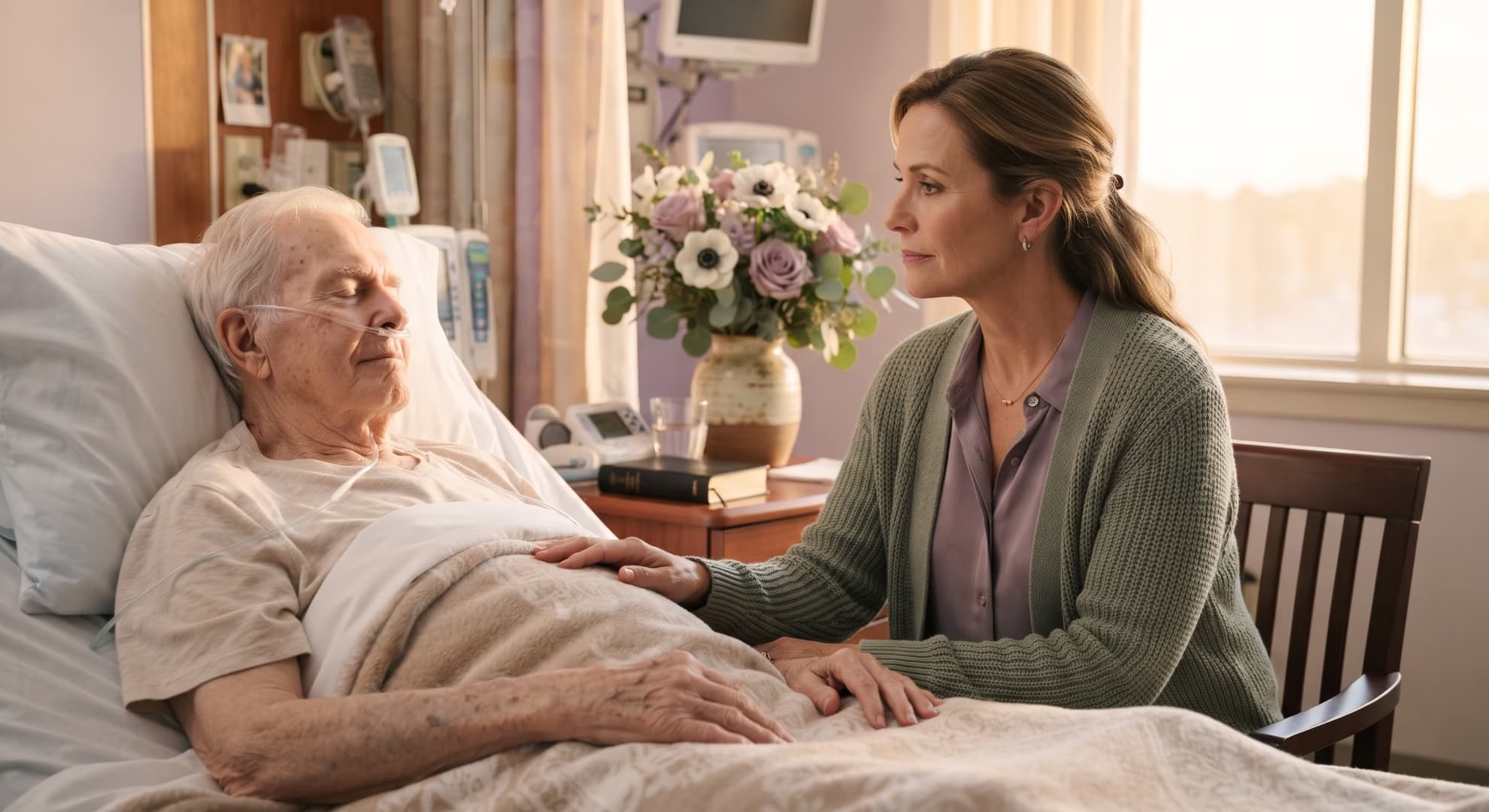


The daughter has been sitting beside her father for six hours when the sound starts, a low, drawn-out moan that rises and falls with each breath. She leans forward, certain it means something urgent, and reaches for the call button before she has even finished the thought.
A moment later she notices his face, and it is not the moan that unsettles her most. It is the way his brow has pulled tight and his jaw has set, a tension that looks, to her eye, exactly like pain. She does not know that one of these two signs is very likely nothing to fear, and the other may be asking for her attention in a way the moan never was.
This is the particular difficulty of a bedside in the final days of a life. Two signs can arrive together, sound and expression overlapping in the same hour, and a family with no training in either has no reliable way to tell which one is speaking the truth and which one is not.
Treating them as a single category, both equally alarming or both equally dismissible, is where a great deal of unnecessary fear and, at times, unnecessary suffering begins.
DISCLOSURE: This post contains affiliate links. When you purchase through these links, I may receive a small commission that helps me continue to provide these resources for your journey, at no extra cost to you. I only recommend resources I believe in.
Two Signs, One Assumption
Families keeping a vigil tend to gather every visible and audible change into a single mental folder labeled suffering, and they respond to the folder as a whole rather than to what is actually inside it. A moan gets filed there. So does a tightened jaw. So does labored breathing, restless hands, a furrowed brow.
The instinct to combine these signs is understandable. Nothing in ordinary life teaches a person to sort them, and a frightened family member standing at a bedside for the first time has no occasion to have learned the difference before it matters.
The physiology beneath the two signs in question, however, does not support treating them the same way. A moan or a groan in the final days of life is very often produced by air passing across relaxed vocal cords during an unconscious exhale, a passive mechanical event with no more relationship to felt distress than a snore has to a bad dream.
The sound can be loud. It can rise and fall in a way that mimics the cadence of genuine anguish. It is, in the great majority of cases, simply what breath does when it moves through tissue that a dying body no longer controls with any intention behind it.
Clinicians who have documented the physical course of advanced illness describe this vocal pattern as a predictable feature of a body’s final hours rather than as a sign requiring correction.1
Facial tension does not carry the same clean explanation, and this is precisely the distinction a family needs to hold onto. A grimace, a tightened brow, a clenched jaw, or a pulled-back mouth belong to the small set of physical signs that pain researchers have identified as genuinely informative in a person who can no longer speak.
Standardized tools built for exactly this purpose, most widely used in dementia and end-of-life care, treat facial expression as one of the strongest available indicators of unaddressed pain in someone who has lost the capacity to report it in words.2
When the Face Tells the Truth
This does not mean every tightened face at a bedside signals pain that requires treatment. A mouth that has gone dry from reduced fluid intake can pull the lips and jaw into a shape that resembles a wince.
Muscle tone changes as the body approaches its final hours, and a face that has lost some of its usual animation can settle into an expression a family reads as distress simply because it no longer looks peaceful.
The work of telling these apart from a face that is actually registering pain is not a task most families have the training to perform alone, and it is not meant to be.
What separates a pain grimace from these benign changes is usually a cluster of features rather than any single one: tension that appears or worsens with movement, turning, or a dressing change; a grimace that eases after a scheduled dose of pain medication rather than persisting regardless of what is done; a tightening that co-occurs with a rise in heart rate or a change in breathing pattern.
Clinical guidance on symptom assessment in advanced illness has long emphasized this cluster approach precisely because no single facial sign, taken in isolation, reliably separates genuine pain from the ordinary physical changes of active dying.3
The vocalization, meanwhile, rarely needs this kind of clustering to be understood correctly. A moan that continues at a steady, breath-linked rhythm regardless of positioning, medication timing, or the presence of family in the room is, in the overwhelming majority of documented cases, the passive product of relaxed anatomy rather than a communication of anything at all.
The sound asks nothing of the people in the room. The face, when it is genuinely registering pain, is asking something real, and the two should not be met with the same response simply because they arrived within the same hour.
Where a Death Doula Reads Both
A death doula who has sat through many vigils brings a specific and useful discipline to this exact moment: the capacity to look at a moaning, grimacing face and separate what it is actually reporting from what it merely resembles. This is not a diagnosis, and it does not replace the ongoing clinical assessment the hospice or medical team is already providing.
It is an act of steady, informed observation offered in real time, at the bedside, while the family is still deciding whether to reach for the call button or simply hold the hand in front of them.
The death doula’s contribution here is less about naming a rule and more about modeling a habit of attention. Watching whether the tension in the face changes with repositioning. Noticing whether the moaning continues at the same steady rhythm through a scheduled medication dose or eases afterward.
Asking the hospice nurse a specific, informed question rather than a general one born of panic. None of this requires medical training on the family’s part. It requires only someone in the room who already knows what to watch for, and who can translate what is actually happening into language the family can use immediately rather than absorb only after the fact.
This distinction matters most in the moments when a family is deciding whether to ask for more medication, whether to worry that something has gone unaddressed, or whether to simply stay present and let a passive sound continue without alarm.
A death doula who can read the difference in real time protects the family from two opposite and equally costly mistakes: dismissing a real signal of pain because it arrived alongside a sound that meant nothing, or escalating every sound and expression into a crisis that the physiology does not support.
What a Family Can Watch For
A family does not need clinical training to begin noticing the difference between these two signs, only a small amount of guidance about what to actually watch for. Timing is the first and most useful clue.
A moan that rises and falls with breathing and continues at the same pace no matter what is happening in the room is behaving like the passive vocal sound it almost certainly is. A grimace that intensifies specifically during turning, bathing, or repositioning, and that eases in the half hour following a scheduled dose of pain medication, is behaving like a genuine pain response.
It also helps to resist responding to every sound with an immediate request for more medication and to resist dismissing every facial change as meaningless. A brief, direct question to the hospice team, framed around what was actually observed rather than around the fear the observation produced, tends to get a more useful answer than a general report that something seems wrong.
Families who want a fuller sense of what this kind of attentive presence looks like across the whole of a final vigil, not only at the moments when a specific sign appears, will find that working with a death doula through the active dying period offers exactly this form of steady, informed companionship at the bedside.
None of this requires the family to become clinicians. It requires only a shift from treating every visible and audible change as one undifferentiated category of alarm, toward treating each sign on its own terms, with someone present who already knows which terms apply.
The Shift Toward Attention
What tends to change for a family once this distinction has been named is not the intensity of what they feel at the bedside, but the accuracy of where they direct it. The fear does not disappear. It becomes more useful, aimed at the moments that actually call for it rather than spread evenly across every sound and every expression in the room.
A family that has been shown the difference between a passive moan and a genuine grimace stops treating the whole of a vigil as a single unbroken alarm, and starts treating it as a series of specific moments, some of which ask for action and most of which ask only for presence.
Families navigating the wider landscape of physical signs that arrive in the final days, including the circulatory changes that produce a very different kind of misunderstood alarm, may find useful grounding in the earlier post The Skin Discoloration Families Mistake for Harm, which addresses a different sign entirely but the same underlying task of telling appearance apart from what the body is actually doing.
The daughter beside her father eventually stops reaching for the call button every time the moaning rises. She has been shown, gently and in plain terms, what the sound is and is not, and she has learned instead to watch his face, checking whether the tension eases after his next scheduled dose or holds steady regardless of what anyone does. When it eases, she lets herself rest. When it does not, she asks a specific question rather than a frightened one, and gets an answer that actually helps.
By the following evening, the moaning has softened into something closer to breath alone, and the tension in his face has not returned since the last adjustment to his medication. She does not know, and cannot know, exactly what her father is experiencing in these final hours. What she knows now, and did not know six hours earlier, is which of the signs in front of her were asking something of her, and which were simply the sound and shape of a body completing its own quiet work.
That knowledge does not make the vigil easier. It makes it possible to spend the hours that remain paying attention to the right things, rather than to all of them at once.
References
- Twycross, Robert. “Symptom Management in Advanced Cancer.” A clinical reference on the physical course of advanced illness, describing the passive mechanics behind sounds such as moaning and death rattle in the final days of life. ↩︎
- Regnard, Claud, and Sue Hockley, eds. “A Guide to Symptom Relief in Palliative Care.” A practical clinical guide distinguishing genuine pain behaviors from the ordinary physical changes of active dying, including facial tension unrelated to pain. ↩︎
- Doyle, Derek, Geoffrey Hanks, Nathan Cherny, and Kenneth Calman, eds. “Oxford Textbook of Palliative Medicine.” A standard clinical reference addressing nonverbal pain assessment tools and the cluster of signs used to identify pain in patients who can no longer report it in words. ↩︎
Leave a Reply